


No. 14, 2025 | 26 September 2025
Go to:
From FRSA's Executive Director
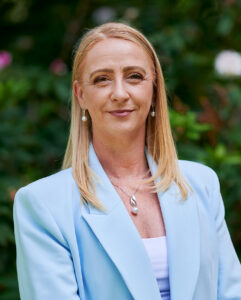
Last week I attended the advance screening of the SBS limited series – The People via Robodebt – at the Theatre at the Australian Parliament House. There are some very brave people featured in the documentary/docuseries who were significantly impacted by the Robodebt fiasco – some tragically. One thing that struck me as a constant message that came through each of the people who shared their experiences and expertise about the failings of the Government’s welfare system at that time (more specifically around analysis of payments and potential debts) was that human beings/people were removed from the process. A fully automated system was brought into effect drawing on data from Services Australia and the Australian Taxation Office. But the human checks and balances that normally happened in the ‘old system’ were gone. Further – it seemed that accessing ‘real people’ to ask questions/and or make complaints was very difficult to do.
We all know that the world is changing due to technological advances and that our workforce and service delivery also needs to keep pace – especially with the significant advances in Artificial Intelligence (AI). As FRSA looks to how we can support our Members in their AI journey we can never lose focus on the human natured focus of the sector’s work. Navigating what is possible and what is suitable will be a key consideration of the AI journey for the FRS Sector. We look forward to delivering a program at the upcoming Strategic Leadership Forum that will have a strong focus on AI. For the FRSA CEOs and Senior Managers reading this eBulletin – if you are yet to register – I do encourage you to do so. Along with key speakers from the Department of Social Services and the Attorney-General’s Department – we promise to deliver an event that will be informative and inspiring.
In other member specific news – the FRSA Board Nomination process is open! This information was sent directly to our FRSA Member Delegates at each of our member organisations. IF you missed it or cannot find it – please get in touch with the team at the office on 02) 6162 1811. Nominations close on Monday, 10 October 2025 (4pm AEDT).
I am also delighted to advise that we have a new employee starting with FRSA, Rhys Jaconley who will be the Family Law Communities of Practice Project Officer. We are very excited to have received such a strong support for the EOIs for the Family Law Communities of Practice and look forward to getting those up and running with the first sessions being held in November. With Rhys due to officially start next week – information about dates and times will be out soon.
Although May next year and Conference 2026 seems some time away – I did want to ask you to start thinking about the Conference Call for Abstracts process that we will be releasing next week. We take great pride in running an event that showcases the work of the sector. So – I encourage you to start thinking about the contribution you would like to be making at Conference 2026.
I am heading off for a fortnight’s holiday with my family. Robyn Clough will be Acting ED whilst I am away – leading the amazing team here at FRSA.
Kind regards,
Jackie Brady
FRSA Executive Director



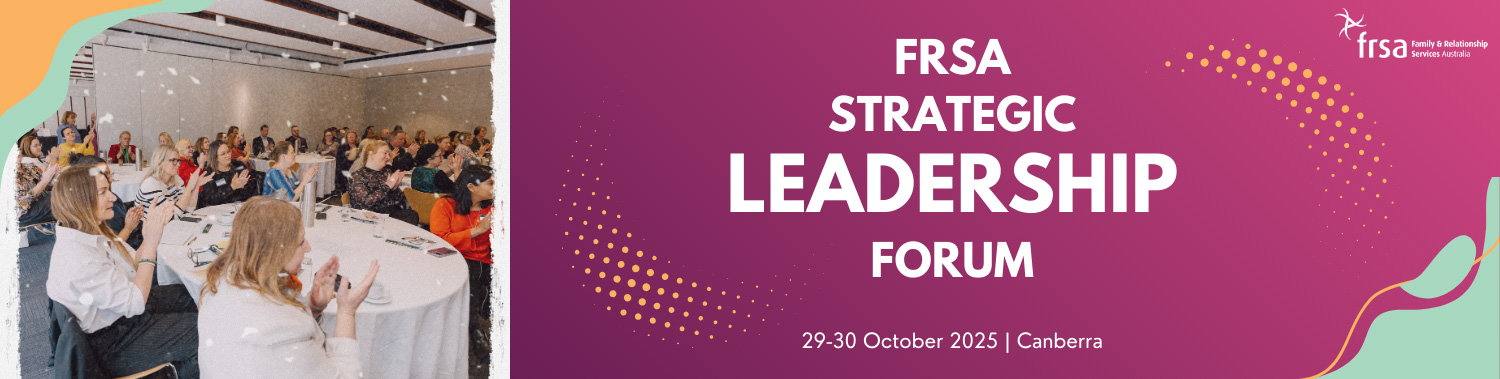
Don’t wait to secure your spot—register today for the FRSA Strategic Leadership Forum 2025!
We are looking forward to welcoming the CEOs and Senior Leaders in the FRSA Membership to Canberra to participate in the Strategic Leadership Forum being held 29 October and 30 October 2025. We are working hard preparing the schedule of meetings for Day 2.
We will endeavour to arrange meetings with MPs and Senators from your electorate and/or State/Territory for your Parliamentary visits on Day 2!
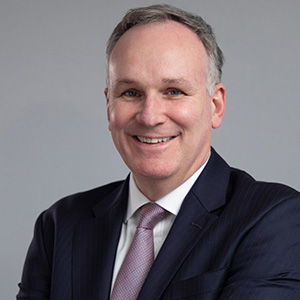
We are delighted to announce our final line up of speakers for Day 1:
Acting First Assistant Secretary, Children and Families Division, Attorney-General’s Department |
Global Futurist and Change Strategist |
Secretary, Department of Social Services |
CEO, InfoXchange |
|---|---|---|---|
 |
 |
 |
 |
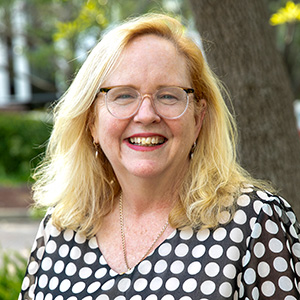
An AI focused panel discussion featuring those from the sector. Panellists:
Chief Executive Officer, Relationships Australia Canberra & Region |
Executive Manager, Engagement & Growth, Better Place Australia |
General Manager, IT & Corporate Support, Anglicare WA |
|---|---|---|
 |
 |
 |
Access to the event details including the event program, speaker information and accommodation will be available on the FRSA Members Only Event page.
Please contact events@frsa.org.au for the password to the FRSA Member’s Only Event page.
Register for the second FRSA First Nations webinar!
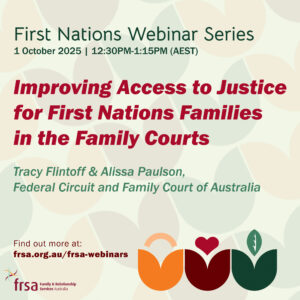 Register for the second webinar in our First Nations focus on Family and Relationship services series, Improving Access to Justice for First Nations Families in the Family Courts presented by Tracy Flintoff and Alissa Paulson from Federal Circuit and Family Court of Australia next week on Wednesday, 1 October 2025.
This webinar will explore how the Federal Circuit and Family Court of Australia is improving access to justice for Aboriginal and Torres Strait Islander families. Discover how the court’s culturally responsive model—including Indigenous Family Liaison Officers (IFLOs) and Specialist Indigenous Lists—is breaking down barriers and offering practical, supportive alternatives to traditional child protection approaches.
View the full webinar schedule below:
| Date and Time | Webinar | Presenter |
|---|---|---|
| Wednesday, 15 October 2025
12:30PM-1:15PM AEDT |
SistaCare – Collaboration for the safety of women | Sarah Todd & Dorothée Crawley, CatholicCare Wilcannia-Forbes |
| Wednesday, 5 November 2025
12:30PM-1:15PM AEDT |
Better Together | Anne-Marie Mioche, CatholicCare Wilcannia-Forbes and Alister Ferguson, Maranguka |
| Tuesday, 25 November 2025
12:30PM-1:15PM AEDT |
Growing Up Strong from early childhood: Stories and other findings from Footprints in Time: The Longitudinal Study of Indigenous Children | Stuart Ekberg and Tirritpa Ritchie, Flinders University and Kristin Laurens, Queensland University of Technology |

FRSA at SNAICC National Conference 2025
 FRSA is a Ruby sponsor for this year’s SNAICC National Conference in Meanjin/Brisbane next month from 7-9 October.
The theme for SNAICC’25 is Our Culture. Keep it Strong. We Belong. reinforcing the importance of keeping Culture strong and celebrating that strength. It also references the importance of cultural identity and belonging in the lives of Aboriginal and Torres Strait Islander children.
Labour Force Status of Families
 Australian Bureau of Statistics (ABS) has released their latest report on the Labour Force Status of Families. Labour Force estimates of families are produced from data collected in the monthly Labour Force Survey.
The report found that Australia now has over 7.7 million families, and workforce participation is on the rise — especially among dual-income couples and single-parent households. The latest ABS data shows nearly three-quarters of couple families with kids have both parents employed, a significant jump from 60% in 2005. However, 1.4 million families remain jobless, including 233,000 with dependent children, highlighting ongoing challenges for vulnerable groups.
Key statistics
In June 2025:
- There were 7.7 million families, an increase of over 1.0 million since June 2015.
- There were 1.4 million jobless families, which represents 18.5% of all families.
- 271,000 one parent families were jobless.
- Almost three-quarters (73%) of the 2.2 million couple families with children aged 0-14 years had two employed parents
Latest HILDA data gives insight into a changing Australia
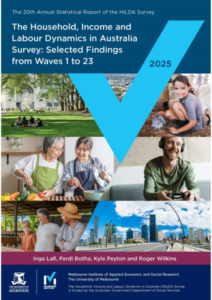 The 2025 statistical report for the Household, Income and Labour Dynamics in Australia (HILDA) Survey has been released, providing a snapshot of how Australians are living.
The HILDA Survey interviews the same 16,000 people every year, providing a unique opportunity to assess how economic and social factors are affecting the everyday lives of Australians.
Capturing data up until 2023, this report is the first to consider data collected in the peak of the cost-of-living crisis that followed the COVID-19 pandemic.
The survey has shown that changing economic factors are having a major influence on the life decisions made by Australians, including:
- Delaying retirement – In 2003, 70% of women and 49% of men aged between 60 and 64 were retired. By 2023, those rates have dropped considerably to 41% of women and 27% of men.
- Renting retirees being left economically vulnerable – The proportion of retirees living in private rentals has roughly doubled over the last twenty years, while the wealth gap widens between retirees who own a home and those who do not.
- Fertility rates at risk of further declines as desired number of children drops – Australia is at risk of a further decline in fertility rates, with respondents reporting they want fewer children and smaller families compared to 20 years ago.
- Households spending more on rent, tax, childcare – In 2023, the average household spent 21.1% less on childcare and 3.3% less on rent than they did in 2021.
- Fewer friends, less socialising contributing to well-being decline – Australians have reported having fewer friends than they did in 2001, a trend that was already on the decline but then accelerated by the COVID-19 pandemic.
National gambling study finds more Australians harmed amid rising participation
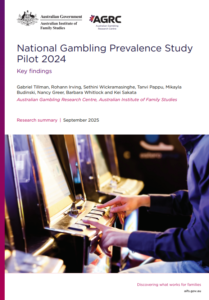 New research by the Australian Gambling Research Centre (AGRC) at the Australian Institute of Family Studies (AIFS) has revealed gambling participation and harm is rising in Australia, and is linked to other serious issues including suicidal thoughts, intimate partner violence and financial stress.
The National Gambling Prevalence Study Pilot study was conducted in 2024 and was based on a nationally representative survey of 3,881 Australian adults.
Nearly two in three (65%) Australian adults gambled at least once in the last year, and more than one in seven (15%) experienced gambling-related harms – an increase of 8 and 4 percentage points respectively since 2019. Nearly one in three adults (32%) gamble at least monthly.
An estimated 3.1 million people adults (15%) experienced harms such as feeling guilty and stressed about their gambling, borrowing money or selling things to fund gambling, or going back another day to try to win back lost money.
Among high-risk gamblers, 16% reported experiencing suicidal thoughts, compared to 4% of low-risk gamblers. 19% of people whose partner gambled weekly or more reported experiences of intimate partner violence, compared to 7% of people whose partners did not gamble.
66% of high-risk gamblers reported serious financial stress, such as going without meals or sold belongings to cope.
Younger adults were found to be particularly affected, with 18–24-year-olds who gamble regularly nearly twice as likely to be at high risk of harm compared to older age groups. Among First Nations Australians, 27% reported experiencing gambling harms – nearly double the rate of non-Indigenous Australians. Read the full report

National Adaptation Plan
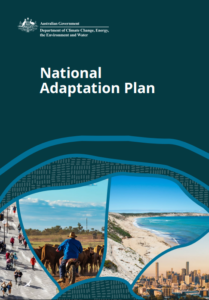 The policy framework responds to risks from Australia’s national climate risk assessment, setting priorities and guiding principles for government-led adaptation. It outlines current and future actions across seven systems – economy, infrastructure, environment, primary industries, health, communities, and defence – while recognising climate risks identified by Aboriginal and Torres Strait Islander peoples. Supplementary documents cover adaptation in government policies and the international context.
Read the National Adaptation Plan.
Treasury evaluation strategy: embedding a culture of evaluation
 This strategy explains the approach to evaluation at the Australian Department of the Treasury. Treasury recognises that effective monitoring and evaluation is important at all stages of the policy cycle. The strategy outlines a set of strategic priorities and actions to support evaluation planning, delivery and capability in Treasury.

2025 Residential Care Awards
Congratulations to FRSA Members who won and were nominated at the Centre for Excellence in Child and Family Welfare’s 2025 Residential Care Awards (ResiROCKS).
The awards are given each year in recognition of the exceptional work carried out in the field by residential carers in Victoria. The aim of the awards is to recognise, celebrate and encourage work of the highest standard that contributes to positive outcomes for children and young people living in residential care.
- Anglicare Victoria’s Trevor Dray won the Leadership Award
- Hakim Rahimi from Anglicare Victoria and Harvey Falcasantos from CAFS were joint winners for the Residential Carer Award
- Ash Webb from Anglicare Victoria was a joint winner of the Education Award
- Andrew Dodds from Anglicare Victoria won the RCLDS Learner Award
- MacKillop Family Services’s Emily Ramsay won the Judges Award: Cultural Connection Champion
Congratulations to the following who made it as finalists:
- Gemma Cassingham from MacKillop Family Services for the Leadership Award
- MacKillop Family Services’s Emily Ramsay for the Cultural Engagement Award
- Jacqui Anile from MacKillop Family Services and Mark Guy from Anglicare Victoria for the Hall of Fame award
- Frances O’Brien from MacKillop Family Services, Jenny Harrison and Kayleigh McCabe from Anglicare Victoria for the Education Award
- Alexandra Handley and Stephanie Williamson from Anglicare Victoria and Dione Maxwell from MacKillop Family Services for the Residential Carer Award
Report: 2025 Your Voice
 yourtown launched its Your Voice Report 2025, which brought together the views of more than 4,000 young people aged 12–25 and highlighting urgent reform needed across safety, mental health, education, and the rising cost of living.
The survey revealed overwhelming concern about domestic, family and sexual violence, with 82% rating it as the most urgent issue facing young Australians. Many described feeling unsafe, unheard, and unsupported by current systems and in their homes, schools, and communities.
Mental health also emerged as a clear priority, with 70% identifying it as the top area for government reform. Young people said they were dissatisfied with the affordability and accessibility of services and called for a shift away from crisis-driven care towards early intervention, stigma reduction, and youth-led support.
The cost-of-living crisis was rated as critical by three in four respondents (75%), who pointed to housing stress, income support, and education costs as major barriers to their wellbeing. Many called for reform of Youth Allowance and more affordable housing options, while others suggested a “Youth Card” to ease education and transport expenses.
The report 2025 sets out eight key recommendations for reform, including the creation of specialist youth guides in government services, early intervention hubs, equitable pay for young workers, and safer, more supportive school environments. Read the full report
Vale Helen Rimington
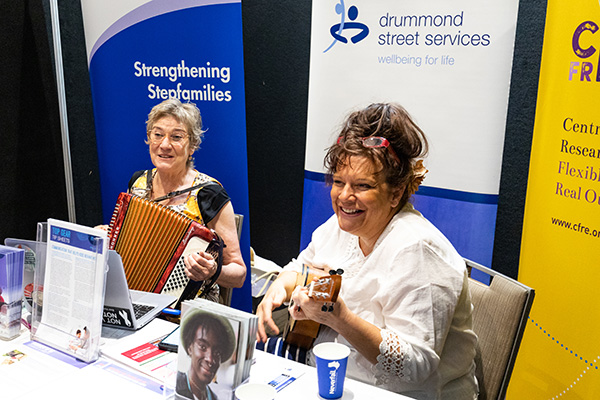
FRSA was deeply saddened to hear the news that after a long illness, Helen Rimington from Drummond Street Services has passed away.
Helen was part of Drummond Street Services for 20 years, having many roles such as leading their family and parenting services work, youth services, and held the role of deputy CEO. Helen played a vital role in shaping Drummond Street and the broader family and parenting sectors.
In her 35-year career, Helen contributed so much to the sector and was a pioneer of youth peer support programs, including PATS, which became the national peer-based model for young people with a parent with mental illness. Her work to reduce the stigma of mental illness in communities, workplaces and for everyday people, changed the way we talked about, understood and responded to mental health and illness. She simplified strategies for good mental health and managing psychological distress and made them accessible for all.
In their tribute message to Helen, the Drummond Street Services team said, “Helen’s presence is still felt every day in our work and in the lives of the individuals, families and communities she supported. Her impact has been profound and lasting, and she will be dearly missed by all who had the privilege of knowing her.”
We extend our heartfelt condolences to Helen’s family, friends and colleagues.
Report: Building a resilient and sustainable workforce for the future
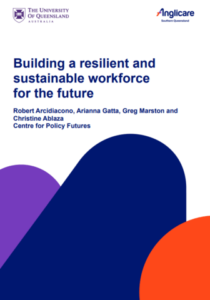
The community services sector in Australia plays an essential role in enabling individuals and communities to reach their full potential. However, the sector is experiencing increasing challenges in attracting and retaining workers. The University of Queensland’s Centre for Policy Futures were engaged by Anglicare Southern Queensland to conduct research on this and have released the report, Building a resilient and sustainable workforce for the future.
This research sought to understand the barriers and enablers of a sustainable workforce – focused on aged care and youth worker roles. Key findings:
- Job security is key not only for workforce attraction but also to increase the representation of men in this highly feminised industry.
- While experimenting with flexible work arrangements can be an avenue for attracting workers, the sector is not best placed to be a ‘disruptor’, as introducing radical innovations presents significant practical challenges.
- While providing concrete pathways for career development and adequate organisational support is key for retaining staff, organisations need to carefully tailor their job advertisements to avoid inadvertently signalling job stress.
- Qualification barriers could be addressed by exploring models that combine employment with paid training and by finding pathways that recognise lived experience and transferable skills from other sectors.

World Mental Health Day
 World Mental Health Day is on 10 October 2025. The theme for this year’s Mental Health Australia World Mental Health Day campaign is “Connect with your community”.
Connecting with our communities – the people and places where we feel safe, seen and heard – can help us feel cared for and supported, which is good for our mental health.
Find out more on how get involved via Mental Health Australia’s website or download free digital assets and use the hashtag#WMHD2025 and #connectwithyourcommunity on social media.
National Youth Parliament EOIs Open
 The 2026 National Youth Parliament will bring together 150 senior school students, one from each federal electorate, for a five-day residential program in Canberra to debate, learn and represent their communities. It is open to young people aged 16–17 living in Australia in August 2026, with no restrictions on background, education, or experience.
Applications close 21 November 2025, with succsful participants notified by 2 March 2026. All travel, accommodation, meals and activities are fully funded, ensuring equal access for participants. Find out more.
Free AI scholarship
 Infoxchange, with support from Google.org, are offering free scholarships for training in AI on Coursera to not-for-profit staff across Asia-Pacific. Upskilling in AI and obtaining official certifications will help those who attend stay ahead of the pack in the new AI-focussed workforce, boosting career and helping accelerate impact on the frontline. Find out more
National approach to worker screening in the care and support economy consultation
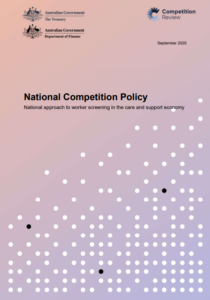 The Australian Treasury and Finance Departments are consulting on a national worker screening system for the care and support economy, covering aged care, disability, early childhood, veterans’ care, and related sectors. The current patchwork of checks across jurisdictions creates duplication, delays, and added costs for workers and providers. Two reform options are being considered: expanding mutual recognition of existing checks, or introducing a single national screening system.
Submissions are open until 7 October 2025, and stakeholder input will be critical in shaping the final approach. Find out more.
Call for particpants: Best Practices for Engaging Parents in Child Sexual Abuse Prevention Education in Early Childhood Settings project
Australian Catholic University is inviting parents of children aged 0-5 in childcare and professionals in early childhood education to take part in a study by Donio Khoshaba, supervised by Prof Daryl Higgins.
The research project aims to explore the current perspectives surrounding child sexual abuse (CSA) prevention education targeted at parents of children in early childhood, particularly between the ages of 0-5. It aims to do this by speaking to both parents, and providers of early childhood education to understand both perspectives surrounding what education is currently being implemented what education is missing, along with what are the barriers and enablers to both engaging parents and educating parents.
If interested, read the participant information sheet or contact ICPS@acu.edu.au.
LiFE Award Nominations – now open
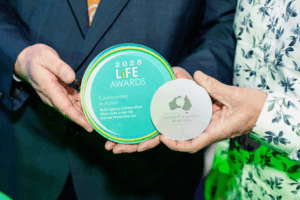 For over two decades, the Suicide Prevention Australia LiFE Awards – Living is For Everyone have recognised outstanding contributions to suicide prevention.
The LiFE Awards aim to showcase the important work being done in states and territories across Australia by individuals and organisations to prevent suicide and support those in need.
There are six categories that recognise the diverse and innovative efforts being undertaken to save lives and reduce suicide. These categories acknowledge individuals and organisations at a state and territory level, with all award recipients automatically proceeding as finalists in the national awards.
Inquiry: Quality and safety of Australia’s early childhood education and care system
Submissions for the Senate Inquiry into the quality and safety of early childhood education and care are closing soon on 3 October 2025.
The inquiry will examine the effectiveness of the regulatory framework, the pressures facing the workforce, and whether the current funding model supports quality and safety. It will also provide a platform for families, educators and advocates to share their experiences, and deliver recommendations for both immediate improvements and long-term reforms towards universal early learning.
The inquiry is set to report back in March 2026. Find out more or upload your submission.

CHC81015 Graduate Diploma of Relationship Counselling – June 2026, Online
CHC81115 Graduate Diploma of Family Dispute Resolution – July 2026, Online
Couples Counselling Course: A contemporary and client-focused approach

SA
Family Dispute Resolution Practitioner | Uniting Communities
QLD
Family Dispute Resolution Practitioner – Mackay | CatholicCare Central Queensland
Family Dispute Resolution Practitioner – Rockhampton | CatholicCare Central Queensland
Practice Lead | Interrelate
NSW
Relationship Counsellor | Interrelate
Manager headspace Batemans Bay | Relationships Australia Canberra & Region
Couple and Family Counsellor | Relationships Australia NSW
NT
Financial Counsellor | Anglicare NT
VIC
Regional Family Dispute Resolution Practitioner (RFDRP) | Mallee Family Care
If you have any events you’d like listed on the FRSA Events and Training Calendar or job vacancies you’d like listed on the FRSA Jobs Board, email Communications Officer, Vanessa Lam at communications@frsa.org.au. Please note that posting onto the FRSA website is reserved for FRSA Members only.

Social media minimum age: regulatory guidance | eSafety Commissioner
 The regulatory guidance sets out reasonable steps for social media platforms to comply with Australia’s new Social Media Minimum Age obligation, effective 10 December, which requires preventing children under 16 from holding accounts. It outlines guiding principles and expectations, including the use of age assurance technologies, layered safeguards, and improved reporting, while rejecting self-declaration as sufficient. Platforms are also expected to monitor, communicate transparently, and continuously improve systems for detecting, removing, and preventing underage accounts.
 This policy brief examines how systemic racism in Australian hospitals continues to affect the experiences and outcomes of Aboriginal and Torres Strait Islander patients, and outlines the evidence needed to drive reform. It highlights the need for a nationally coordinated approach led by Indigenous voices and backed by clear policy direction, consistent standards and comprehensive data collection.
Better practice in responding to family violence handbook | Essential Services Commission Victoria
 This handbook serves as a practical guide to help energy and water businesses assess and strengthen their response to family violence. It reflects deepening understanding about family violence risk in essential services, including the importance of taking a Safety by Design approach – a framework to anticipate, detect and eliminate harm before it occurs.
Infant and toddler mental health resources | Emerging Minds
In honour of Mental Health Week coming up, Emerging Minds have put together infant and toddler mental health resources to build skills and confidence and help create more opportunities for infants and toddlers to develop strong mental health from the very start.
Education and training divides: gendered skills, pathways and outcomes | Jobs and Skills Australia
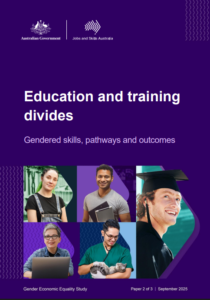 Education and training choices, skills, outcomes and pathways – like jobs, work and pay – are highly gendered in Australia. This report provides insights on these education and training divides. It shows that gendered patterns in education and training remain deeply entrenched, with little sign of change that could shift Australia’s occupational gender segregation.
Youth Voices | Commission for Children and Young People
This initiative from the Commission for Children and Young People is a place for children and young people to share their stories about the big issues that affect them. These stories play a critical role in raising awareness of the issues that children and young people are facing, to advocate for positive change and influence the systems they interact with.
How the care economy is reshaping the labour market | e61 Institute
Since the introduction of the NDIS, Australia’s care economy has expanded rapidly, driving strong labour demand in this female-dominated sector. This growth has particularly benefited younger women, with improved employment prospects for those under 35 and a narrowing gender pay gap, which has fallen by around 3.5 percentage points over the past decade. Women now out-earn men per hour on average from their teens to early 30s, though care jobs continue to rank lower on flexibility, career progression, and overall satisfaction. The sector also offers greater job security due to sustained government support and ongoing demand.
The impact of Commonwealth Rent Assistance on low-income privately renting parents and children | AHURI
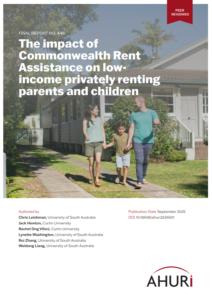 This research examined how Commonwealth Rent Assistance (CRA) influences housing, financial, health, and wellbeing outcomes for low-income families and their children, with a focus on breaking cycles of disadvantage. Findings show that CRA recipients still face greater hardship than non-recipients, the payment level is too low, particularly disadvantaging smaller families and that raising CRA could significantly reduce children’s risk of homelessness. Positive long-term outcomes for children are most likely when families use CRA to access better housing rather than simply easing immediate financial stress.
The impacts of CCTV on victim-survivors of domestic and family violence | Australian Institute of Criminology
In Australia, victim-survivors of domestic and family violence (DFV) are increasingly using closed-circuit television (CCTV) systems. This paper presents the findings from a world-first study into how victim survivors of DFV experience the use of CCTV systems. The findings demonstrate that CCTV can have beneficial impacts on the wellbeing of victim-survivors but also carries risks.
Improving outcomes for young people transitioning from out-of-home care in Victoria | Monash University
 When young people transition from out-of-home care (OoHC) at 18 years of age their experience of disadvantage is compounded, with care leavers at risk of poor outcomes post-transition. This project aims to generate new knowledge to inform the development and implementation of evidence-based innovations for young people as they transition from OoHC.
Dealing with distressing content online | eSafety Commissioner
Online spaces should be safe for everyone, but you may sometimes come across content that is distressing – especially if it shows extreme violence or acts of terrorism. eSafety has put together information about what to do and how to get support if you see online content that is seriously harmful and disturbing.
Victim-survivors’ perspectives on post-custodial measures for people with convictions for sexual offending | Australian Institute of Criminology
The number of people convicted of sexual offences in Australian prisons is rising, making effective post-custodial measures critical for reintegration and reducing reoffending. An Australian study explored victim-survivors’ views on such measures, examining their reasons for supporting or opposing different approaches. Victim-survivors generally supported interventions like electronic monitoring, private offender registers, psychological treatment, parole supervision, and Circles of Support and Accountability, but held mixed views on public registers, highlighting the need to centre their perspectives in policy design.
Want to submit something to the FRSA eBulletin?
If you have an news item or event that you would like to be featured in a future eBulletin please submit your announcement via the form below or email communications@frsa.org.au with the subject “FRSA eBulletin submission”.
Please note FRSA members receive priority for items posted in the eBulletin. And to keep information current, relevant and useful, submissions will not be repeated from week to week.
Subscribe
Subscribe to receive future eBulletin editions directly to your inbox!
