


No. 18, 2025 | 21 November 2025
Go to:
From FRSA's Executive Director
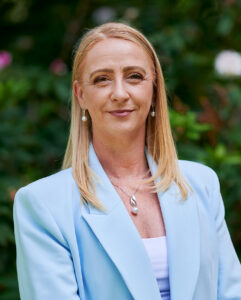
The last fortnight has been a time of intense conversations with our membership and other key stakeholders as we work up our response to the Commonwealth Government’s consultation on A new approach to programs for families and children. Discussions with the Department of Social Services have made it clear that this consultation process – albeit with a very challenging timeframe – is designed as the final opportunity for people to influence the direction the Commonwealth Government will be taking in designing a program to support activities that contribute to two proposed outcomes:
- Parents and caregivers are empowered to raise healthy, resilient children.
- Children are supported to grow into healthy, resilient adults.
The consultation paper speaks to greater flexibility, less administration and a more streamlined approach to the delivery of programs with three activity streams:
- National programs and information services – making sure families across Australia have access to trusted advice and resources, wherever they live.
- Prevention and early intervention – supporting families early, before challenges escalate.
- Intensive family supports – for families who need more targeted, wraparound support.
The family and relationship services sector has been consistently, diligently and effectively delivering programs that support and assist children, young people and adults to stay out of the more costly tertiary end of service systems – whether that be child protection, justice or health/mental health systems and contribute to stronger and safer communities. The success of these programs was made clear in the CIE FRS cost benefit report we published in September 2023 which found that for every $1 government spent on funding the programs in the Families and Children’s Activity the cost benefit (value returned to government and society) was an aggregate $8.67. Not to blow our own trumpet – but in the Cost Benefit Analysis world – this is money well spent. And importantly, that money is representative of the improvements made to the lives of children, young people and adults accessing those services.
As the peak representing the FRS sector we feel well placed – with strong historical evidence of success and demonstrated outcomes – to provide constructive advice and input to Government in the final deliberations around the future of this important work.
In the last fortnight we also held the FRSA AGM and I encourage you to check out our Annual Report for 2024-2025. We also welcomed and congratulate newly elected FRSA Board Director, Danielle Newport, CEO of Relationships Australia WA and thanked outgoing board member Graeme O’Connor, CEO, Interrelate, who filled the position on a temporary (casual) basis.
I am delighted to report that the FRSA Conference is already gaining strong momentum and we can’t wait to bring a fantastic program to life in the city of Brisbane. Abstracts closed on Wednesday last week and we had a bumper 192 abstracts submitted. That is a record and we are so grateful that people see the FRSA Conference as such a great opportunity to showcase their work. We will be working to get results of the abstract review process out to authors and a concurrent session program out to the sector before 2025 is out! (Only 33 days away!)
Kind regards,
Jackie Brady
FRSA Executive Director



FRSA welcomes Danielle Newport as a Board Director
 FRSA is pleased to welcome the newly member elected Board Director to the FRSA Board, Danielle Newport, CEO, Relationships Australia WA.
Danielle will take up a 3 year appointment on the FRSA Board. With over a decade of governance experience in Australia and the UK, Danielle brings a passion for strengthening community services and ensuring quality outcomes for clients. Her journey includes three years on the National Disability Services board during the rollout of the NDIS, where Danielle championed diversity and choice for communities. A Fellow of the Governance Institute and AICD graduate, Danielle combines strong financial and risk expertise with a deep commitment to constructive, contemporary governance. She said she looks forward to supporting FRSA and its members to build a sustainable sector that makes a real difference in people’s lives.
Thank you to all nominees who stood for election – Graeme O’Connor, Teena Ingram and Kirsty Wallman. And thank you to Graeme for filling the recent casual vacancy on the FRSA Board.
Register for the final FRSA First Nations webinar!
 Register for the final webinar in our First Nations focus on Family and Relationship services series, Growing Up Strong from early childhood: Stories and other findings from Footprints in Time: The Longitudinal Study of Indigenous Children presented by Associate Professor Stuart Ekberg & Tirritpa Ritchie, Flinders University & Professor Kristin Laurens, Queensland University of Technology on Tuesday, 25 November 2025.
Discover how the Longitudinal Study of Indigenous Children (LSIC) is being used to tell powerful stories—combining Indigenous knowledge, storying methods, and data—to understand what helps children thrive. In this webinar, researchers will share how they have adapted Indigenous storying methods to bring LSIC data to life, guided by a strengths-based approach and Indigenous conceptions of social and emotional wellbeing. Learn how culture, place, and strong families support wellbeing, and how these insights can shape better services and stronger communities.
FRSA Annual Report 2024-25 launched
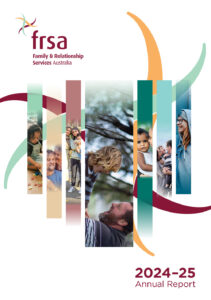 FRSA’s Annual Report for 2024-25 was launched at the Annual General Meeting on Wednesday 12 November 2025 by FRSA Board Chair, Allison Wainwright.
FRSA’s annual reports provide an overview of FRSA’s activities during each 12 month period (July-June). This includes program activity and evaluation, policy and advocacy, research, events and the financial report for that period.
FRSA National Conference 2026 - Sponsorship Prospectus available
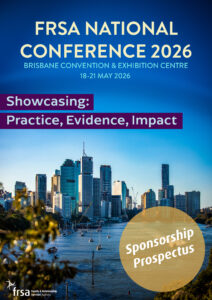 Sponsorship has always been a big part of FRSA’s Conferences and in acknowledgement of this support, we have designed packages that will allow for maximum visibility to showcase the work and activity of your organisation/business. See our Conference Sponsorship Prospectus below for more details.
This year’s Conference is expected to attract 600+ delegates, including practitioners, researchers, managers, executives, and policy and program developers from government and non-government agencies.
FRSA is delighted that the Department of Social Services and the Attorney-General’s Department have committed as Conference Partners for the 2026 Conference. And we’re excited to welcome Drummond Street Services and Centacare Brisbane as Gold Sponsors!
We welcome your support of the conference and hope that you will take advantage of the opportunities available to you in joining with FRSA as a Conference 2026 sponsor.
If you are interested in a more bespoke package for your organisation don’t hesitate to get in touch with the FRSA team on (02) 6162 1811 or events@frsa.org.au.

Child Poverty in Australia 2025
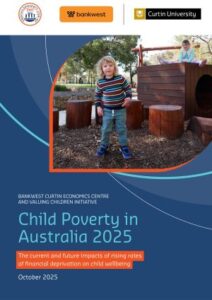 New data from the Child Poverty in Australia 2025 report, released by the Bankwest Curtin Economics Centre (BCEC) and the Valuing Children Initiative (VCI) for the End Child Poverty campaign, revealed more than 950,000 Australian children are experiencing food insecurity, poor housing conditions, and limited access to education and healthcare driven by rising housing costs, widening inequality and a failure of income support to keep pace with inflation.
Key Findings:
- Child poverty has increased by 236,350 children over four years – a 33% increase.
- The rate has risen by 3.2 percentage points since 2021.
- The report projects 950,100 children will be living in poverty in 2025, up from 868,350 in 2023. This represents a rise of 81,750 children in just two years.
- Projected 15.6% of children living in poverty in 2025 – up from 15% in 2023.
- Single-parent households are most affected, with 36.6% living in poverty.
- This trend confirms the risk of surpassing 1 million children in poverty this year.
The report is available here.
Jobs Availability Snapshot
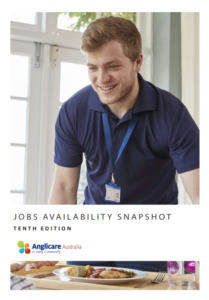 Anglicare Australia has just released its Jobs Availability Snapshot 2025, which shows that Australia’s job market is locking out people who most need a chance to work.
The Snapshot measures how many jobs are available for people who don’t have qualifications or recent experience.
It found that:
- For every entry-level vacancy, there are 39 people on the JobSeeker payment
- Of those, 25 have barriers to work. This is the highest ratio ever recorded by the Snapshot
- Entry-level jobs now make up just 11 percent of all vacancies. This is their lowest share in a decade.
This year’s Jobs Availability Snapshot shows that unemployment is a structural problem, not a personal one. Anglicare Australia is calling for a government policy response that addresses structural barriers, including:
- Creating quality, entry-level jobs
- Overhauling employment services to replace punitive compliance measures with practical support
- Raising the rate of income support payments so that people aren’t living in poverty as they look for work.
Read the snapshot here.
National Memorial for Victims and Survivors of Institutional Child Sexual Abuse
Last week, the Government, working together with victims and survivors, selected the final design for the National Memorial for Victims and Survivors of Institutional Child Sexual Abuse.

The chosen design embodies protection, strength, and enduring connections, and offers a space for healing and reflection shaped by the voices of victims and survivors.
The National Memorial will be located in the heart of the nation’s capital, on Canberra’s Acton Peninsula near the National Museum of Australia and the Australian Institute of Aboriginal and Torres Strait Islander Studies.
It will acknowledge the experiences of victims and survivors, honour the lives lost, and recognise the courage of those who fought for justice and those whose voices were not heard. It will also serve as a place of truth, reflection and healing for victims, survivors, their families, supporters, and the broader community.
The National Memorial aims to educate all Australians about the harmful and lasting impacts of institutional child sexual abuse, providing a permanent reminder of our shared responsibility to protect children now and into the future.
Construction of the National Memorial is scheduled to commence in 2026, with completion expected in 2027. Find out more
ACNC releases findings of review into charities operating within complex structures
The Australian Charities and Not-for-profits Commission (ACNC) has released a summary of a review into charities operating within a complex structure, identifying how these charities practice good governance and manage risk.
The term ‘complex structure’ isn’t defined and covers various types of arrangements, see examples. Typically, it covers those operating as a ‘group’, where there are multiple entities, perhaps with more than one type of legal structure and/or entities with various purposes (for-profit and charitable).
The review found charities achieved satisfactory governance by:
- demonstrating why their use of a complex structure assisted in fulfilling their charitable purpose
- tailoring their governance practices to their specific structure, often with the support of specialist advice
- periodically reviewing their structure and governance practices to ensure arrangements and practices were fit for purpose.
Some ways charities are managing issues around risk and governance include:
- holding separate board meetings for each entity within the group and ensuring record-keeping is well managed for each entity
- establishing group policies and governance frameworks – where appropriate – to apply consistent risk and compliance practices
- providing on-going training on governance and directors’ duties to ensure obligations are understood
- obtaining independent, specialist advice for specific legal, financial or governance matters that may impact the entire group or a specific entity within it
- periodically reviewing the structure to ensure that it remained suitable for the charities’ needs, and that governance and compliance requirements were being appropriately managed.
Prevalence of traumatic events in childhood
A recently published study led by researchers at the University of Sydney has found 42 percent of Australian Adults experienced a traumatic event as children. Those affected have a 50 percent higher risk of developing a mental health or substance use disorder than the wider population.
The study found, on average, half of childhood trauma occurred before the age of 10, sometimes occurring in children as young as six. The most common experiences included the unexpected death of a loved one, sexual assault, and witnessing domestic violence, serious injury or death.
The study also found strong links between childhood trauma and chronic conditions such as asthma, arthritis, cancer and kidney disease.
Lead authors, Dr Lucy Grummit and Associate Professor Emma Barrett from the Matilda Centre for Research in Mental Health and Substance Use say that the findings highlight a need for urgent investment in trauma-informed support to better protect children and prevent lifelong mental health impacts.
The study builds on the recent Australian Child Maltreatment Study, which provided the first national estimate of abuse and neglect.
The prevalence of potentially traumatic events in childhood and associations with mental disorders, suicide and physical health in adulthood study is available here.
16th anniversary of the National Apology to Forgotten Australians and Former Child Migrants
16 November 2025 marked the 16th anniversary of the National Apology to Forgotten Australians and Former Child Migrants, delivered by former Prime Minister Kevin Rudd.
It is an opportunity to reflect on the horrors that occurred between the 1920s and 1990s, where more than 500,000 children were forcibly removed from their families, and placed in homes, orphanages, and other forms of out-of-home care.
This practice created lasting pain for those who were denied the safe and loving childhood they deserved. It is a tragedy that continues to touch the lives of survivors, their families, and the generations that follow.
In recognition of the ongoing needs of victim-survivors affected by their time in institutional care, the Albanese Government has announced a two-year extension for the Find and Connect Support Services Program.
The extension will ensure 11 existing providers will continue to deliver vital services until June 2028 and builds on the Government’s $940,000 funding injection provided this year.
In 2024-25, Find and Connect has helped over 3,700 individuals access services like specialist counselling, referral services, peer support, education, group sessions, and social support programs, and locating records and reconnecting with their families.
To access Find and Connect Support Services, you can call 1800 16 11 09 or visit the Find and Connect website.

National Mental Health and Suicide Prevention Agreement Inquiry Report
 On 11 November, the Productivity Commission’s final report on the Mental Health and Suicide Prevention Agreement Review was tabled in Parliament.
The review found the Agreement is not effective and a new policy architecture is needed to articulate the collective actions that will deliver changes to the mental health and suicide prevention system and improve outcomes.
Key findings:
- The mental health and suicide prevention system is fragmented and out of reach for many people.
- The actions in the Agreement do not advance system reform.
- Key commitments in the Agreement have not been delivered and should be completed as a priority.
- A new policy architecture is needed to articulate the collective actions that will deliver changes to the mental health and suicide prevention system and improve outcomes.
- The current Agreement should be extended until June 2027 to allow sufficient time for co-design of the new policy architecture.
- The next agreement should comprise clear objectives, specific and measurable outcomes, and tangible commitments linked to the objectives and outcomes.
- The next agreement should formalise the role of the National Mental Health Commission as the independent entity responsible for assessment and reporting on progress.
Read the Final Report here.
Standing Council of Attorneys-General communiqué
The Standing Council of Attorneys-General met on 14 November 2025 in Brisbane.
The key items discussed included:
- Child Safety – Working with Children Check reform
- Closing the Gap Justice Targets
- Responses to gender-based violence
- Responses to the abuse of older people
- Model law on electronic transferable records
- Legal Aid preferred supplier fees
- Vicarious liability and institutional accountability for child abuse – Bird V DP
- Retail safety – privacy reform update, including facial recognition technology
- Workplace protection orders
- Use of AI in the Australian legal system.
Read the communiqué here.
Working with Children Check reform
The Attorney-General, the Hon Michelle Rowland, has announced a commitment of $37 million to implement the National Continuous Checking Capability (NCCC). The funding will be provided over five years from 2025-26.
This capability will provide continuous, near-real time monitoring of national changes to criminal history information on Working with Children Check (WWCC) holders. The NCCC pilot will be ready for states and territories to progressively onboard from the end of 2025.
Progress has also been made towards implementing national mutual recognition of negative WWCC decisions, first announced in August this year. This means a person rejected for a WWCC in one jurisdiction will be rejected in other jurisdictions.

Rise in separated couples who continue living together
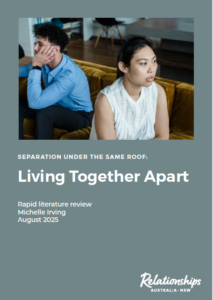 A new rapid review from Relationships Australia NSW has revealed how housing and cost-of-living pressures are reshaping separation in Australia – with more couples remaining in the same home even after their relationship has ended.
Practitioners are increasingly seeing couple separation under the same roof (SUSR) because they cannot afford to live apart. For many families this is a financial or practical necessity, often to maintain stability for children while trying to navigate the emotional complexities of separation.
In a snapshot of 19 practitioner cases, more than half of couples said they stayed under one roof because they couldn’t afford separate housing. While some noted fewer disruptions for children, most described ongoing tension, blurred boundaries and significant emotional strain. Financial stress and safety concerns were also common – especially where there’s a history of domestic or family violence. Experiences varied widely, from cooperative co-parenting to ongoing conflict and uncertainty about roles. A small number of clients also reported receiving legal advice not to leave the family home, even when conflict was high.
The review highlighted the need for stronger recognition of SUSR across policy, research and service design. Key recommendations include:
- Better data collection on how many families are affected and for how long.
- Tailored supports such as mediation, counselling and financial advice.
- Cross-sector collaboration between housing, legal and family service systems.
Relationship Matters launch new branding and Workplace Matters
 Last month Relationship Matters launched their new branding and a new, easier to navigate website to help people find the right services and resources more quickly.
“Our new look celebrates connection, care and growth – the same values that have guided us for over 78 years,” said Chief Executive Officer, Maya Avdibegovic.
“It is a modern reflection of how we work alongside people and organisations to strengthen relationships and create safer, more supportive communities.”
The organisation has also renamed their workplace wellbeing and training services to Workplace Matters. In partnership with New Way Lawyers, they launched Safe and Supported at Work, Australia’s first program offering free, confidential counselling and legal support for employees impacted by family violence. Watch a video from the launch below with Maya and The Hon Ged Kearney MP:
Accordwest's new CEO
 Danelle Milward has been announced as Accordwest’s new Chief Executive Officer.
Danelle is an experienced leader with over 25 years in health, disability, and community services across government and non-profit sectors. She has held senior roles at Therapy Focus and the National Disability Insurance Agency, where she led evidence-based service delivery with a focus on excellence, drove strategic planning, and built strong collaborative partnerships. Danelle is passionate about values-based leadership and creating meaningful outcomes for individuals and communities.
FRSA congratulates Danelle on the role and we look forward to working together in the future.
Kath Kerin appointed interim CEO at UMFC

The Chair of the Board of Upper Murray Family Care, Dean Bocquet, announced late last week that Felicity Williams had resigned as the CEO of UMFC and that Kath Kerin had been appointed as Interim CEO. Congratulations to Kath. Kath (who is also UMFC’s Executive Director of Child, Family and Community Services and known to many in the network) has been working in the Social Work field 27 years in a range of leadership and management roles in Child and Family services, Women’s Health, community development and Disability services.
As Felicity is a Board appointed Director, her resignation as CEO will not impact her position on the FRSA Board and we look forward to continuing to work with her in that capacity.

2026-27 Pre-Budget Submissions
The Albanese Government is inviting individuals, businesses and community groups to submit their ideas and priorities for the 2026–27 Budget.
The 2026−27 Budget will continue the Government’s work on Building Australia’s Future.
Submissions must be lodged by Friday, 30 January 2026, to allow their views to feed into the Budget development process. More information is available on The Treasury website.
CFCA Needs and Impact Survey 2025
 The Child Family Community Australia (CFCA) Needs & Impact Survey for the child and family sector is now open!
If you use CFCA or Australian Institute of Family Studies research or resources in your work, they want to hear from you!
Your feedback will shape their upcoming resources so they can ensure they are relevant to you and easy to use.
This is also your opportunity to tell them your topics of interest and information gaps in your work, to help inform future resources.
This survey only takes 10-15 minutes to complete and closes 30 November 2025. Click here to complete the survey.
Survey: Making sure everyone can access services to help prevent child sexual abuse
 A research team at the University of the Sunshine Coast is conducting a short, anonymous survey to understand how accessible sexual abuse prevention services are for children, young people and families.
The survey will take approximately 5 minutes to complete and closes 31 December 2025. Click here to complete the survey.

CHC81015 Graduate Diploma of Relationship Counselling – June 2026, Online
CHC81115 Graduate Diploma of Family Dispute Resolution – July 2026, Online
Couples Counselling Course: A contemporary and client-focused approach

NSW
Relationship Counsellor | Interrelate
If you have any events you’d like listed on the FRSA Events and Training Calendar or job vacancies you’d like listed on the FRSA Jobs Board, email Communications Officer, Vanessa Lam at communications@frsa.org.au. Please note that posting onto the FRSA website is reserved for FRSA Members only.

Underage use of adult-based platforms: risks and experiences | Australian Institute of Criminology
The risk-taking behaviours of children on adult-based platforms are largely unknown. This article presents findings on the online and offline behaviours of young people in Australia who, as children, used an adult-based platform. It found that children are exposed to risk both online and offline as a result of using these platforms.
The Adolescent Man Box | Jesuit Social Services
 This report shines a light on the realities of what it means to be a teenage boy in Australia today. It highlights both promising signs and critical challenges to address to support boys in leading fulfilling lives – free from violence and other harmful behaviours. It provides recommendations for immediate policy and practice reform, and systemic reform.
Should the JobSeeker payment be paid more often? | e61 Institute
This paper explores the idea of halving the JobSeeker payment but doubling its frequency from a fortnightly to weekly payment. The paper documents JobSeeker recipient spending patterns and finds they face more financial stress, experience greater spending volatility and withdraw higher rates of cash than New Zealand recipients who receive weekly payments.
Opportunities to address alcohol policy as part of a holistic approach to preventing violence against women | Our Watch
 A new policy brief highlights the strong links between heavy alcohol use by men and increased violence against women, particularly among men who embrace aggressive and dominance-based forms of masculinity. It urges governments to explicitly address this connection in law, policy and regulation, and calls for alcohol harm-minimisation strategies to be embedded within national gender-based violence prevention efforts. The brief emphasises reshaping drinking cultures that celebrate male aggression, challenging harmful masculine norms, and strengthening controls on alcohol advertising, marketing, sale and delivery. Key reform opportunities include updating state and territory liquor laws to prioritise harm minimisation and recognise domestic, family and sexual violence as alcohol-related harms, as well as tightening regulations on advertising that targets men or links drinking with masculinity and control.
A national responsibility: Actions towards reconciliation | Our Watch
 This report outlines some of Our Watch’s actions in 2024 to prevent violence against Aboriginal and Torres Strait Islander women and their children.
It highlights the work to raise awareness, shift attitudes and drive systemic change – grounded in truth-telling, valuing lived experience, and addressing the ongoing impacts of colonisation and racism.
Interventions for migrant and refugee men who use domestic, family and sexual violence | Australia’s National Research Organisation for Women’s Safety
 For migrant and refugee families in Australia, domestic, family and sexual violence (DFSV) is perpetrated within the context of complex social factors. This review presents an analysis of current knowledge on interventions for migrant and refugee men who have used DFSV. It identifies best practice principles, programs and models relevant to implementation in Australia.
Organisational allyship: An Aboriginal and Torres Strait Islander view | Emerging Minds
In the first episode of this two-part series podcast, Grant Sarra, a Goreng Goreng man from Queensland, joins us to share an Aboriginal perspective on what organisational allyship looks like for individuals, teams and broader organisations.
Grant shares his personal story, rooted in Goreng Goreng Country and his Italian heritage, and highlights the impact of colonisation, racism and intergenerational trauma. He emphasises the importance of knowing who you are, where you come from and how this shapes your worldview and actions.
Grant talks through how authentic allyship requires sitting, listening and learning before acting, walking in parallel with communities rather than ahead of them. He emphasises that allyship is about honour, integrity, dignity and humility, not ego or recognition.
Creating trans-inclusive forms | Transgender Victoria
 Forms are a useful tool to quickly capture information to populate databases, perform staff and client intakes, and more. Filling out a form with your personal information may seem easy, but for many transgender, gender diverse and non-binary (TGD) people it can be less straightforward. This resource from Transgender Victoria outlines some options of how you can change any forms you have to be more accessible and safer for TGD people to use.
Voices of care leavers: ageing with dignity after childhood institutionalisation | Monash University
This study presents a comprehensive national investigation into the ageing experiences of people who spent their childhoods in forms of institutional or out-of-home care in Australia. Care Leavers and stakeholders consistently called for trauma-informed care to become the foundation of aged care practice. The report presents eight key policy and practice recommendations.
Measuring Australia’s digital divide: 2025 Australian digital inclusion index | ARC Centre of Excellence for Automated Decision-Making and Society, RMIT University, Swinburne University of Technology, Telstra
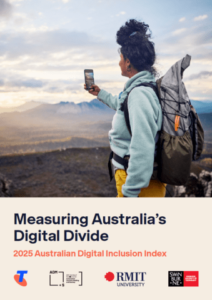 The latest Australian Digital Inclusion Index report shows that while digital inclusion is steadily improving nationwide, significant gaps remain for older Australians, First Nations people and those experiencing social and economic disadvantage. The Index tracks access, affordability and digital ability, offering detailed case studies and practical recommendations to guide action. Key priorities include stronger national coordination and accountability, concessional broadband for low-income households, treating home internet as essential infrastructure, ensuring online services are accessible to all, improving digital ability across communities, and setting clear targets to support safe engagement with emerging technologies such as generative AI.
Want to submit something to the FRSA eBulletin?
If you have an news item or event that you would like to be featured in a future eBulletin please submit your announcement via the form below or email communications@frsa.org.au with the subject “FRSA eBulletin submission”.
Please note FRSA members receive priority for items posted in the eBulletin. And to keep information current, relevant and useful, submissions will not be repeated from week to week.
Subscribe
Subscribe to receive future eBulletin editions directly to your inbox!
