


No. 6, 2026 | 24 April 2026
Go to:
From FRSA's Executive Director
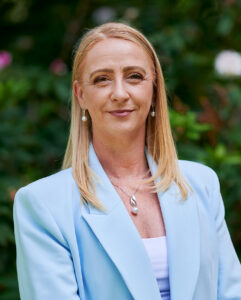
Just before the Family Law Council meeting I was attending today got underway, a media release issued by National Commissioner for Domestic, Family and Sexual Violence, Micaela Cronin, arrived in my inbox raising her concerns that the economic and global uncertainty is increasing levels of family violence risk for an increasing number of people – especially as the cost of living crisis continues. As I had noted last week, the Commissioner did acknowledge that ‘when households face rising financial stress, housing insecurity and instability, the risk of violence increases.’ The Government is very committed to staying on the front foot in response to this issue and I do encourage those among our readership to keep communicating what they are seeing to us, to their FAMS, or to their local members. You are often working with people on the cusp of crisis so your perspective is vital.
I am delighted to advise that the Hon Ged Kearney, Assistant Minister for Social Services and Assistant Minister for the Prevention of Family Violence will be representing the Minister for Social Services, the Hon Tanya Plibersek at our conference in May. Registrations are still open and given the Conference is recognised by Community Work Australia (attendees can claim 10 CPD hours for their participation) another great reason to attend.
This week, we also saw the Minister for Health deliver the news detailing a significant overhaul of the National Disability Insurance Scheme. It is obvious the announcement has caused a lot of uncertainty for many people living with disabilities, their families and support networks. We are also awaiting further advice as to the shape of the Thriving Kids Program the Government had previously announced would be designed to provide better supports to children than what they are currently receiving on the NDIS. I did come across an interesting interview with the Co-Chair of the Thriving Kids advisory group Professor Frank Oberklaid, speaking to what he sees as the significant merits of the new program. Part of that model relies heavily on a community based system of support for children and their families, rather than individualised support. The announcement about NDIS more broadly this week also re-introduced the concept of rebuilding capability among community organisations to host genuine participation activities, through a $200 million fund – the Inclusive Communities Fund – with Government acknowledging the introduction of the NDIS had enabled these types of programs to ‘wither’.
 In FRSA news I am pleased to announce that following an Expression of Interest process to fill the casual Board vacancy on the FRSA Board, Graeme O’Connor, CEO of Interrelate has been appointed by the Board to fill this role until the FRSA AGM being held on 25 November 2026 (as per the FRSA Constitution). Welcome back Graeme! He will also sit on two of the Board Committees, the Research and Policy Committee and the Sector Events Committee who are going to be extremely active with the Strategic Leadership Forum being held in Canberra, 16 & 17 September 2026 and the FRS Workforce Project currently underway and working to an end of October deadline. Busy times ahead!
For tomorrow though, Anzac Day, it does give us a moment in time and in our busy lives to pause and honour the courage and sacrifice of those who served and continue to serve our nation – ‘Lest we forget’.
Kind regards,
Jackie Brady
FRSA Executive Director



Keynote announcement
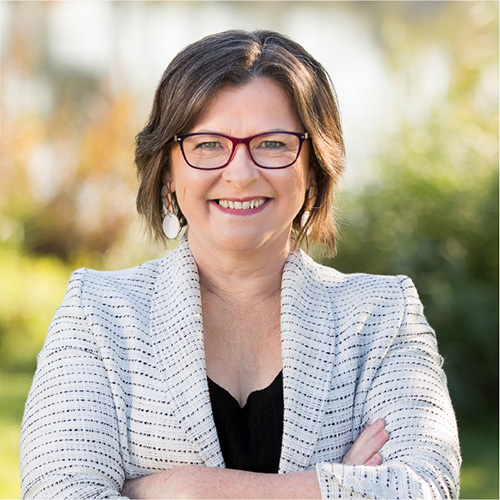 It’s less than a month until the FRSA National Conference 2026 in Brisbane and we’re excited to announce that Assistant Minister for Social Services and Assistant Minister for the Prevention of Family Violence, The Hon Ged Kearney MP will be joining us on day three to deliver a Keynote Address.
It’s not too late to register!
Registration details are available on the Conference website including registration and pre-conference workshop rates.
The FRSA National Conference 2026 provides a platform to showcase and learn from on the ground practice, policy, and research. The Conference is the must-attend event for anyone passionate about family and relationship services.

‘Holding together, Just’ - Latest ANU poll data
The Australian National University (ANU) has released findings from the March 2026 wave of the ANUpoll, which finds that Average life satisfaction is lower than during the COVID-19 lockdowns and more than one in three Australians are finding life difficult or very difficult on their current income.
The latest wave of the ANUpoll surveyed 3,662 adult Australians against the backdrop of the war between the US/Israel and Iran, the subsequent closure of the Strait of Hormuz, and their effects on petrol and other prices. It is the 29th wave of the ANUpoll since October 2019 tracking wellbeing outcomes, economic anxiety, democratic attitudes, and measures of social cohesion. The study was conducted from 11-26 March.
The ANU poll found:
- Nearly three-in-five (59.1 per cent) Australians think life was better 50 years ago, and a similar proportion (58.5 per cent) expect it to be worse in 50 years’ time.
- The proportion of employed Australians concerns that machines or computer programs will replace their jobs has almost doubled since 2018, reaching 30.3%.
- Satisfaction with the way democracy works has remained broadly stable with almost two-thirds of Australians (65.7 per cent) satisfied or very satisfied.
- Core democratic values command very strong support, with more than nine-in-10 Australians agreeing that no one should be above the law, and more than eight-in-10 supporting the media’s right to criticise the government.
You can read more about the ANUpoll findings here.
Care time arrangements after parental separation
 The Australian Institute of Family Studies (AIFS) recently released a new research report – Care time arrangements after parental separation.
The research examined the trends in care time arrangements after parental separation using information on how many nights per year children of separated parents stay with each parent, as recorded in the child support administrative data. Trends in care time arrangements since 2015, including arrangements beyond shared care and differences by child age, are explored.
The research found that:
- Most payers and payees in the Child Support Program (CSP) data had care arrangements where the mother had primary care or above primary care.
- About 1 in 7 payers/payees were in shared care arrangements (child spending 35%-65% of nights with each parent).
- Payers and payees with father primary and father above primary care arrangements (i.e. father care time of 66%-100% of nights) were the least common, applying to fewer than 1 in 10 payers and payees as at June 2024.
This report can be read alongside the companion report – Changing coverage of the Child Support Program and implications for research on separated parents.
Fembot Debt – new report released
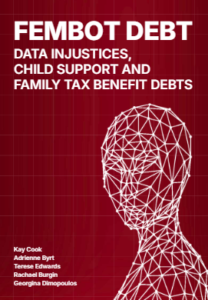 A new report published by Swinburne University – Fembot Debt: Data Injustices, Child Support and Family Tax Benefits Debts has just been released.
The report reveals how the Australian taxation, child support and Family Tax Benefit (FTB) systems are being weaponised as tools of post-separation financial abuse, particularly targeted at single mothers and their children.
The report names the FTB debts that single mothers can incur due to retrospective changes in child support assessment as Fembot Debts. Like the disgraced income averaging practice known as Robodebt, they too are applied automatically. Like Robodebt, they result in significant financial hardship and stress, in this case for single mothers and their children, the most impoverished families in Australia.
Based on survey responses of ~700 single mothers conducted at the beginning of 2026, the report reveals systemic failures that shift responsibility and debts from perpetrators to victims, resulting in financial hardship and ongoing harm to women and children.
The report is published on the Swinburne University website. Single Mother Families Australia has also produced a summary, which outlines key findings and recommendations. The summary is available here.
Economic Inclusion Advisory Committee report released
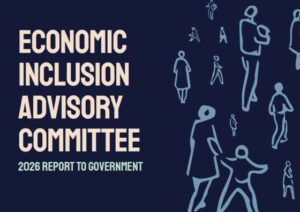 The Albanese Government has just released the Economic Inclusion Advisory Committee’s fourth report to Government on disadvantage and economic exclusion in Australia.
The Government established the Committee in November 2022 to provide independent advice to government before every federal Budget on economic inclusion and tackling disadvantage. The Committee’s membership includes leading economists, academics, philanthropists and community advocates.
This year’s report includes the following priorities:
- Addressing the adequacy of income support payments, including JobSeeker and the Remote Area Allowance (RAA).
- Housing and rental stress – introduce further increases to the rate of Commonwealth Rent Assistance.
- Family Payments and Child Support – measures to address the high rates of child poverty.
- Employment services reforms –Government to commit to a timeframe for the creation of a new employment services system and to replace the current Targeted Compliance Framework (TCF) with a new and less punitive employment services system.
- Poverty measurement – the lack of official poverty measures is inconsistent with Australia’s egalitarian ethos and important international commitments.
- Deep and persistent disadvantage –new analysis highlights how deprivation is significantly more extensive among people receiving income support than among Australia’s population more generally.
The Committee makes a number of recommendations to address the priority areas and notes that increasing the rate of working age payments is its top priority.
You can download the report and find out more about the role and membership of the Committee here.
NDIS changes
On 22 April 2026 the Minister for Disability and the National Disability Insurance Scheme, the Hon Mark Butler MP, announced changes to the National Disability Insurance Scheme (NDIS) in a National Press Club address.
The Minister said that the Government is taking the next steps to restore the NDIS to its original intent of supporting people with permanent and significant disability – and securing the Scheme for future generations.
The Government’s plan to secure the NDIS rests on four pillars:
- Fighting fraud and stopping rorts
- Slowing rapid cost increases
- Clearer eligibility requirements
- Delivering quality services and support to participants.
The Government will introduce the National Disability Insurance Scheme Amendment (Securing the NDIS for future generations) Bill following the release of the 2026-27 Budget. Changes include:
- Tighter criteria for unscheduled reassessment and measures to reduce plan cost growth
- Reset participant budgets for social and community participation and capacity building daily activities
- Introduce standardised, evidence-based assessments to determine access to the Scheme.
- Fraud prevention by:
- Improving the quality of plan managers and support coordinators
- Expanding categories of mandatory provider registration and enrolling providers in a digital payments system.
You can find out more about the changes on the Department of Health, Disability and Ageing website.

Windermere announce new CEO
 Windermere has announced the appointment of Jenny McNaughton as Chief Executive Officer, commencing in early July 2026.
With more than 30 years’ experience in community and human services, Ms McNaughton has led across family violence, child protection, homelessness, disability, foster care and broader family support. She is drawn to Windermere’s strong community connection and evidence-informed, early intervention approach that works alongside children and families to strengthen safety, wellbeing and long-term outcomes.
Ms McNaughton said, “Throughout my career, I’ve seen how powerful early support can be. When we get in early, listen carefully, and build on the strengths that already exist within families and communities, we create better outcomes for children and help families feel safer, stronger, and better supported.”
Ms McNaughton said she was looking forward to listening, learning and working with staff, partners and the community to build on Windermere’s strong foundations.
FRSA looks forward to working with Ms McNaughton in the future.
UMFC appoint new CEO
 Upper Murray Family Care (UMFC) recently anounced the appointment of Tom Mulvaney as their new Chief Executive Officer.
With 20+ years of experience across mental health, child, youth and family services, Tom brings exceptional strategic capability, deep sector expertise, and a values-led, trauma-informed approach to leadership.
In their announcement post, UMFC said “Tom is excited to join our strong, purpose driven organisation and his genuine connection to the Upper Murray region makes him the ideal leader to guide UMFC into its next chapter.”
Tom will commence with UMFC on 15 June 2026, FRSA looks forward to working together in the future.
Webinar: Men’s behaviour change programs across the nation
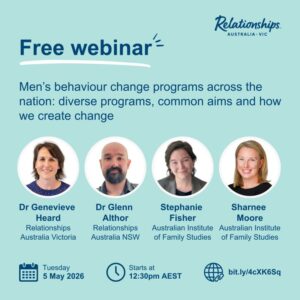 Men’s behaviour change programs (MBCPs) are a key part of Australia’s efforts to prevent violence against women, yet questions remain about when they are effective and for whom.
Relationships Australia Victoria and Relationships Australia New South Wales are delivering a webinar on this on 5 May 2026 at 12:30pm (AEST). The webinar will explore the development of a generalisable Theory of Change to support the evaluation of diverse MBCP models across the Relationships Australia federation. The session will outline key challenges, identify common mechanisms for behaviour change, present the resulting visual model, and discuss how this work is informing the next steps in building a national evaluation framework.

Families Week – Every Family, Everywhere
 Families Week is just around the corner – 11-17 May 2026.
Every May, thousands of people and hundreds of organisations come together for National Families Week, Australia’s annual celebration of families. The aim of Families Week is to celebrate the vital role families play in Australian society and reflect on their importance in teaching, supporting and nurturing children as they grow.
The week coincides with the United Nations International Day of Families on 15 May – a day to mark the importance of families globally and promote awareness of issues relating to families.
Families Week is an initiative of Families Australia.
On Your Terms: Youth survey on consent and sex ed
 The Australian Human Rights Commission has launched an anonymous online survey, which is open to anyone aged 14 to 18 living in Australia.
The survey, which takes 10-15 minutes to complete, is asking young people for their views on consent, respectful relationships and sex education. The insights gathered will help shape how Australian schools teach these topics in the future, supporting schools in building safe and inclusive learning environments.
You can read more about the survey and access the survey link.
AIFS Conference 2026 - Early bird registrations now open
 Early bird registrations are now open for the AIFS Conference, 9-11 September 2026 at the Melbourne Convention and Exhibition Centre. This year’s Conference theme is Changing Families in changing times.
Early bird pricing is available till 30 June 2026. Click here to find out more.

CHC81015 Graduate Diploma of Relationship Counselling – June 2026, Online
CHC81115 Graduate Diploma of Family Dispute Resolution – July 2026, Online
Couples Counselling Course: A contemporary and client-focused approach

NSW
Support Workers (Education, Engagement & Attainment) | CatholicCare Wilcannia-Forbes
Coordinator (Education, Engagement & Attainment) | CatholicCare Wilcannia-Forbes
SA
FAMILY DISPUTE RESOLUTION PRACTITIONER (Qualified or Trainee) | Centacare Catholic Country SA
VIC
Family Dispute Resolution Practitioner | Mallee Family Care
If you have any events you’d like listed on the FRSA Events and Training Calendar or job vacancies you’d like listed on the FRSA Jobs Board, email Communications Officer, Vanessa Lam at communications@frsa.org.au. Please note that posting onto the FRSA website is reserved for FRSA Members only.

Parent, peer and school connections may help reduce suicide risk for young Australians | Australian Insitute of Family Studies
This study is part of the Growing Up in Australia Snapshot series. It contributes to Australian evidence from a nationally representative sample demonstrating that relationships with parents, peers and schools in late adolescence (ages 16–17) have an association with suicidal thoughts and behaviours in emerging adulthood (ages 18–19). In particular, the findings highlight the importance of school belonging during adolescence as a key relational context linked to later mental health outcomes.
Out-of-school suspension from primary school and early contact with police | Australian Institute of Criminology
This study examined associations between out-of-school suspension from primary school and early contact with police (by the age of about 14 years). Longitudinal data from the New South Wales Child Development Study were used to determine the prevalence, pattern and association of suspension and police contact among 68,121 children.
The odds of suspended children experiencing any contact were three times those of non-suspended children (controlling for multiple covariates) and the odds of contact as a person of interest were six times those of non suspended students. Dose response relationships were evident with increasing suspension severity. Systemic intersectoral reform to disrupt the school-to-prison pipeline by enacting effective alternatives to suspension is required.
The struggle to be seen, the power in being heard | Australian Human Rights Commission
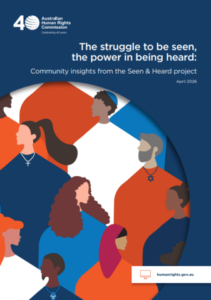 This report reflects the voices and experiences of hundreds of people from Jewish, Muslim, Palestinian, Arab and Israeli communities in Australia. The insights shared by project participants reveal the profound pain and distress caused by increased racism targeting the affected communities. The report also reveals how racism has escalated in these communities.
The cost-of-living crisis and youth mental health | Prevention United
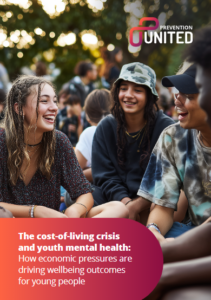 The cost-of-living crisis is not just of economic concern, it is a major social determinant of health, having profound negative impacts on the protective factors for mental health and wellbeing while simultaneously increasing the risk factors for mental ill-health. Young Australians are particularly vulnerable. This publication outlines young people’s experiences of the cost-of-living crisis and impacts on mental health and wellbeing.
Fostering a positive sense of home for children in shared parenting arrangements | Australian Institute of Family Studies
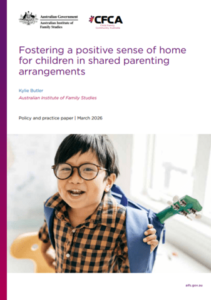 This resource summarises what is known about the meaning of home for children (primary school age and above) following parental separation. It describes some common challenges children face when navigating life across two households and what can help create a positive experience of home post-parental separation.
Creating safer workplaces for women with disabilities | Our Watch
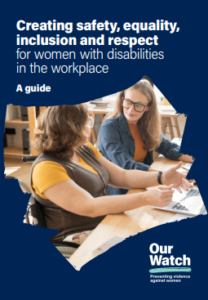 Our Watch has released a new guide on preventing violence against women with disabilities in the workplace, adapted from Changing the landscape and developed with people with lived expertise. It includes practical actions and resources to support gender and disability equality at work.
For the people: future-proofing Australia’s democracy | Grattan Institute
 Democracy is under sustained pressure everywhere. Australia is one of the world’s leading democracies, but we cannot – and should not – take ours for granted. Over human history, liberal democracy is relatively recent, hard won, and precious. Ensuring Australia’s democracy is fit for the times we live in will take work. This report sets out five priorities for Australia to build a better and more resilient democracy.
Culturally safe assistive technology provision in Australia | Australian Journal of Social Issues
This study explores inequities in Assistive Technology (AT) access for Aboriginal and Torres Strait Islander peoples. Secondary analysis identified barriers and facilitators across people, products, personnel, provision and policy, generating nine principles for culturally safe AT delivery. The findings highlight actions needed for respectful and effective AT programs.
2025 National youth survey: summary report | Department of Education
 The report shares the views of young Australians through the 2025 National Youth Survey. The survey provided young people with the chance to highlight the issues that are most important to them; and share their views to improve how young people are included in government decision-making. The report identifies the top five issues for young people.
Want to submit something to the FRSA eBulletin?
If you have an news item or event that you would like to be featured in a future eBulletin please submit your announcement via the form below or email communications@frsa.org.au with the subject “FRSA eBulletin submission”.
Please note FRSA members receive priority for items posted in the eBulletin. And to keep information current, relevant and useful, submissions will not be repeated from week to week.
Subscribe
Subscribe to receive future eBulletin editions directly to your inbox!
