No. 9, 2026 | 16 June 2026
Go to:
From FRSA's Executive Director
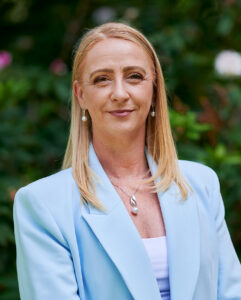
Earlier today, the Department of Social Services opened up consultation on key documents within the Relational Contracting model on the DSS Engage website. These include the Shell Agreement, Governance Framework and Decision Matrix and FRSA will be coming out shortly to our members seeking input into our submission to formally respond to this process that has a closing date of 26 July, 2026.
I have just come out of a Community Services Advisory Group meeting convened this afternoon and chaired by the Assistant Minister, the Hon Ged Kearney. As we had previously heard through presentations at the FRSA Conference, providers of the new Children and Family Support (CaFS) program will be the ‘early adopters’ of the new relational contracting model of Government doing business with the sector. As such, this will be a priority activity for FRSA over the next 5 weeks.
Whilst the Department is yet to release the Grant Opportunity Guidelines for the CaFS program, DSS staff in attendance at that meeting did indicate that the Government has clearly articulated their intention for the outcomes of that program for some time. This includes in the ‘A new approach to programs for families and children Consultation Report’, in material released at the time of the Federal Budget in mid-May where the new program was announced and at presentations and sessions at the FRSA Conference.
We have asked the Department for more information about the timeline that will be used to bring into effect the new CaFS program starting 1 July 2027 outlining the key points and milestones between now and then.
As we know, with the range of consultations out in the sector marketplace at the moment, the Government is clearly looking for improved alignment and connection between the work across Departments – most notably across DSS and AGD at the Federal level. It was good to receive confirmation today at the CSAG Meeting that the Government’s National Plan to End the Abuse and Mistreatment of Older People 2026-2036 is another key area they are bringing into the mix.
World Elder Abuse Awareness Day was celebrated yesterday. Earlier this year, the Australian Institute of Health and Welfare reported that 1 in 6 people in Australia experienced elder abuse in the past year with psychological abuse the most common form of elder abuse. Sadly, 1 in 2 people who perpetrate elder abuse are family members. Only 1 in 3 people who experienced elder abuse sought help from a third party. With the deep and complicated connections to family relationships, the FRS sector is well placed to work in this space – both working with older people experiencing abuse and helping to support positive relationships between older people and their families. It is no surprise that a number of our members are very active in this field, such as Relationships Australia (across Australia), UnitingCare, Better Place and Pronia, to name a few. The significant challenge is securing the funding to adequately respond to the need in society, which sadly is on the increase.
FRSA’s workforce project is well underway and the organisational survey for current providers of DSS Families and Children Activity programs and AGD-funded Family Law Services has been extended until 23 June. See more below.
Kind regards,
Jackie Brady
FRSA Executive Director



FRSA National Conference Presentations and photos now available
Presentation slides from a range of conference sessions have been uploaded to the Conference website. You can find these by going to the Conference Program and clicking on the link for the presentation you are interested in. An audio recording of DSS’ popular presentation on the topic of Relational Contracting will be uploaded to the FRSA Conference website shortly.
Conference photos have also been added to the website, providing an opportunity to revisit key moments and connections from the event.
Australia’s Family and Relationship Services Workforce: Now and into the future - Survey extended until 23 June

The organisational survey for FRSA’s workforce project – Australia’s Family and Relationship Services Workforce: Now and into the future – has been extended until COB 23 June 2026.
The Centre for International Economics (the CIE) is undertaking the project for FRSA and is inviting CEOs/HR Managers from all organisations delivering programs under the Department of Social Services Families and Children Activity and/or programs under the Attorney-General’s Department Family Relationships Services program to complete this confidential survey.
The survey invitation and survey link have been distributed directly to FRSA Member Delegates and to all designated grant contacts through DSS and the Attorney-General’s Department.
The information collected will contribute to a national workforce profile of Commonwealth-funded Family and Relationship Services. The findings will help improve understanding of the current workforce and inform future workforce planning, policy discussions, and sector development activities.
The survey will take 20-30 minutes to complete and includes questions about:
- workforce composition, skills, and qualifications
- recruitment, attraction, retention, and vacancies
- workforce challenges and emerging trends
- future workforce needs and opportunities.
Questions you may have about the process and your privacy are addressed in the attached Frequently Asked Questions sheet
Further information about the project, including how to subscribe for updates, is available at: https://frsa.org.au/frsa-research/frsa-projects/

National Aboriginal and Torres Strait Islander Children's Day
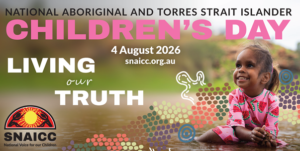 National Aboriginal and Torres Strait Islander Children’s Day is a national celebration of Aboriginal and Torres Strait Islander children held each year on 4 August. The day is led by SNAICC – National Voice for our Children, the national Aboriginal and Torres Strait Islander peak body representing children, young people and families, and is an opportunity for all Australians to recognise and celebrate the strength, pride and potential of Aboriginal and Torres Strait Islander children.
This year’s theme, Living Our Truth, honours the power of truth-telling, the sharing of knowledge across generations and the importance of telling our stories.
Across the country, thousands of early learning services, schools, libraries, sporting clubs, organisations and communities lead their own Children’s Day celebrations in ways that reflect local culture, knowledge and priorities.
You can learn more about Children’s Day here, including ways to celebrate, access to resources and find out about the events happening across the country.
Children’s Day 2026 Ambassador
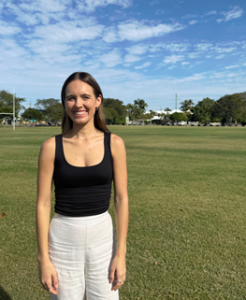 Marlee Silva is the Ambassador for Children’s Day 2026. Marlee is a proud Gamilaroi and Dunghutti woman who grew up on Dharawal Country.
She is an acclaimed writer, television presenter, podcast host and sports commentator, and a staunch advocate for Aboriginal and Torres Strait Islander children, young people and families.
Final decision on the gender undervaluation review of the SCHADS Award
On 1 June 2026 the Fair Work Commission handed down its final decision on the gender undervaluation review of the SCHADS Award.
Key aspects of the SCHADS Award gender undervaluation review decision include:
- A new Final Classification Structure (FCS) will replace Schedules B, C, E and F from 1 October 2027.
- There will be three work streams in the new structure for:
- Social and Community Services,
- Home Care
- Crisis Assistance and Supported Housing.
- Family Day Care is no longer in the Award
- Home care disability workers (Schedule E) receive an interim pay rise of ~15% from 1 October 2026, although this is a preliminary decision.
- Position descriptors have been replaced with recognition of both qualifications and experience, including lived and cultural experience.
- There is a commitment that no current worker will go backwards in pay in the new structure.
- Moving between levels will not be based on FTE hours, but rather continuous services and competency requirements.
FRSA will be looking carefully at the decision over the next few weeks and the implications for our Members. Stay tuned.
ASU files pay increase claim
Now that the final gender undervaluation review decision has been handed down, the Australian Service Union (ASU) has announced it will file an historic work value claim in the Fair Work Commission seeking pay rises of up to 35% for 300,000 community and disability workers. The ASU had paused its work value claim for two years while the gender undervaluation review was undertaken.
Cost of Living Index June 2026
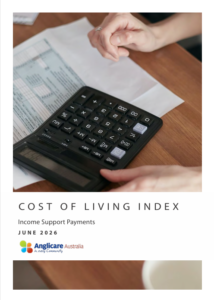 This year’s Cost of Living Index, undertaken by Anglicare Australia, focuses on people receiving working-age income support payments. The findings show that the incomes available through payments such as JobSeeker and Parenting Payment are not enough to cover even basic living costs. Across every household modelled, essential weekly expenses exceed available income before costs such as energy bills, telecommunications, medical expenses or emergencies are even considered.
Anglicare Australia is calling on the Federal Government to urgently raise the rate of JobSeeker and other income support payments.
New report urges action for children and young people experiencing violence
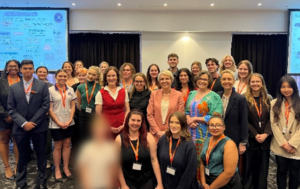 In December 2025, at a roundtable convened by the DFSV Commission and Australia’s National Research Organisation for Women’s Safety (ANROWS), a group of children and young people with lived and living experience of DFSV spoke directly to the Minister for Social Services, Tanya Plibersek, and the Assistant Minister for Social Services and Prevention of Family Violence, Ged Kearney, about their experiences and ideas for the future.
The young advocates identified six priorities for government action in the roundtable report:
- Ensuring accessible, age-appropriate and easy-to-navigate support
- Strengthening education to empower children and young people, their families, schools and communities to prevent and respond to domestic, family and sexual violence
- Providing safe and accessible housing options for children and young people escaping unsafe environments
- Ensuring police interact with children and young people safely and respectfully
- Empowering children and young people to meaningfully participate in family court and justice system processes
- Transforming systems using solutions co-designed with children and young people, enabling individualised and strengthened prevention, support and recovery options.
This work will contribute to shaping the Second Action Plan under the National Plan to End Violence against Women and Children 2022–2032, ensuring children and young people are not only recognised, but prioritised.
You can download the summary report here.
FCFCOA Practice Direction: Use of Artificial Intelligence
The Federal Circuit and Family Court of Australia (FCFCOA) has issued a new Practice Direction on the use of AI.
The Practice Direction outlines the principles and responsibilities for using AI in the Courts and aims to promote responsible AI practices that ensure integrity, accuracy, confidentiality of sensitive information and do not compromise the safety of any court user or child.
The Practice Direction applies to all Court users – litigants, lawyers and experts. It is available on the FCFCOA website.
The King’s Birthday 2026 Honours List
FRSA congratulates recipients of the King’s Birthday 2026 Honours List, and we acknowledge in particular those recipients in the extended FRSA network:
Members of the Order of Australia
- Ro Allen, former CEO UnitingCare Australia (1996-2010), for significant service to the community through social reform and human rights advocacy.
- Mr Robert Dunn, Deputy Chair, BaptistCare, for significant service to international development, to the not-for-profit sector, and to the community
- Emeritus Professor Ross Ernest Griffith, Member, Council of Governing Members, The Smith Family for significant service to tertiary education, to the textile industry, and to the community.
- Mr Robert Dawson Petie, former Deputy Chair (2006-2018), UnitingCare Queensland, for significant service to industrial relations, to corporate governance, and to the community.
- Emeritus Professor Stephen Rade Zubrick, Chair, Consortium Advisory Group, Growing Up in Australia: The Longitudinal Study of Australian Children, 2001-2018, Australian Institute of Family Studies, for significant service to medical science and research, particularly in children’s and youth development.
- Mr Barry Sandison, Board Member ANROWS, former CEO AIHW (2016-2021), former Deputy Secretary, Department of Social Services (2011-2016), for significant service to public administration, particularly in health and welfare.
Medal of the Order of Australia
- Justice Murray Robert Aldridge, Judge, Family Court, since 2012, for service to conservation, to orchid growing, and to the law.
- Mr Richard Grant Giles, Chair Anglicare NT, for service to the community of the Northern Territory.
- Mrs Leone Gwendolen Scott, Ngala -Parenting, Family, Children and Youth Support, for service to child and youth support.
- Mrs Prudence Jean Molnar, Volunteer, Court Network, Melbourne Family and Federal Circuit Courts, since 1999, for service to the community through a range of organisations.
- Mr Peter Andrinopoulos, PRONIA, for service to the Greek community of Melbourne
- Mrs Noline Gai Cornhill, CatholicCare Food Programs since 2021, for service to the communities of Canberra and Forster-Tuncurry.
- Mr John Whitton Haslem, Salvation Army – Chair, Red Shield appeal Bateman’s Bay (2003 – 2005), Chair, Red Shield Appeal (Canberra 1994 -1995), for service to the community through a range of roles.
The King’s Birthday 2026 Honours List can be viewed here.

New National Place Partnership Model announced
On 12 June, the Treasurer, the Hon Jim Chalmers, and the Minister for Social Services, the Hon Tanya Plibersek, announced a new national Place Partnership Model that aims to deliver better outcomes for children and families who need it most.
The model will be rolled out across 18 communities, and those communities will create and lead solutions that meet their local needs. The funding can support geographically specific activities like community-led school engagement and mentoring programs, locally driven employment pathways, youth recreation programs, and tailored family support services like counselling for children.
The 18 in-scope communities already work with government through Stronger Places, Stronger People and Empowered Communities. The model is intended to build on the foundations already in place.
Treasurer Chalmers and Minister Plibersek said, “The model puts community and local leaders in the driver’s seat, to use their local knowledge to better guide where government funding goes, including through initiatives such as the Children and Family Support program.” Just what this means for the new Children and Family Support Program, which will replace the Families and Children Activity, is not currently clear. We trust, however, that further information is imminent.
The 18 in-scope communities are on the Department of Social Services website.
ACNC Australian Charities Report
 The Australian Charities and Not-for-profits Commission (ACNC) has released the 12th edition of the Australian Charities Report.
Based on analysis of 53,641 Annual Information Statements submitted by charities for the 2024 reporting period, the report finds that cost of living pressures are taking a toll on both charities and the communities they support with charity expenses surpassing significant revenue growth.
Key findings:
- Expenses outpaced significant revenue growth
- Total sector employment grew, with charities employing 1.6 million staff, or 11% of Australia’s workforce (up from 10.7%)
- Charities engage 3.9 million volunteers and 53% of charities operated with no paid staff
- More charities report servicing people aged 65 or over with adults 65+ now the third most common beneficiary group.
The report is available on the ACNC website.
Report on Government Services mid-year update
The Productivity Commission’s mid-year update to the 2026 Report on Government Services highlights positive outcomes across several key areas.
New data shows government-funded vocational education and training (VET) graduates experienced significant gains in employment and income, with median earnings increasing by more than $16,000 after training and employment rates rising by 18.3%. School retention rates from Year 10 to Year 12 also improved in 2025, while preschool participation remains high, including among Aboriginal and Torres Strait Islander children, whose enrolment rates continue to increase. The report also notes a rise in Indigenous community housing stock, although overcrowding remains an ongoing challenge. The RoGS provides nationally consistent data on the performance of government-funded services across education, health, housing, justice and community services.
You can find out more here.
Relational Contracting - consultation has just opened
This morning the Department of Social Services opened a consultation on the first batch of draft foundational documents that will underpin its imminent shift to relational contracting for the new Children and Family Support Program (replacing the Families and Children Activity).
Relational contracting is a longer‑term, more flexible partnership approach between government and providers. It focuses on delivering clear and practical outcomes for people and communities. It aims to enable greater collaboration, flexibility and trust, so government and the sector can work more effectively together.
The first batch of documents released include:
- Shell Agreement
- Governance Framework
- Decision Matrix
The department intends to release the following documents soon:
- Readiness Checklist
- Flexibility Policy
- Frequently Asked Questions
- Readiness Roadmap
FRSA will work with our Members to provide consolidated feedback. Submissions close 26 July 2026. Information about the call for feedback, including the draft documents, is available on DSS Engage.
National Strategy to Prevent and Respond to Child Sexual Abuse 2021-2030 – second action plan consultation
Work is progressing to develop the Second Action Plan under the National Strategy to Prevent and Respond to Child Sexual Abuse 2021-2030. The development of a Second Action Plan is an opportunity to address known and emerging challenges, and community concerns and priorities about preventing and responding to child sexual abuse.
A survey is now open for all Australians to share what they believe needs to happen next to keep children and young people safe from sexual abuse and best support victims and survivors.
The survey is available on the Attorney-General’s Department consultation hub. The survey will close at 11:59pm on 17 July 2026.
At the same time, work is underway on related action plans including:
- the Second Action Plan for the National Plan to End Violence against Women and Children 2022–2032 (see public consultation)
- the Second Action Plan for Safe and Supported: The National Framework for Protecting Australia’s Children 2021–2031 (Safe and Supported)
- the Second Aboriginal and Torres Strait Islander Action Plan under Safe and Supported
- the First Action Plan for Our Ways – Strong Ways – Our Voices: National Aboriginal and Torres Strait Islander Plan to End Family, Domestic and Sexual Violence 2026–2036.

2026 Alcoa of Australia Community Award Winner – Mark Glasson
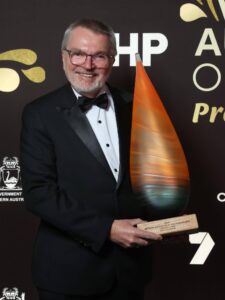 Mark Glasson, CEO Anglicare WA, has won the 2026 Alcoa of Australia Community Award. This award recognises individuals who make an extraordinary contribution to the state of Western Australia.
Mark is a leading voice in Western Australia’s social services sector, with more than 25 years of senior executive experience across community services, justice, local government and social policy. He is also President of WACOSS, former Chair of Shelter WA, Co-convenor of the Home Stretch WA campaign, and a Leadership WA Honorary Fellow in 2023.
Congratulations Mark!
New branding for Centacare New England North West
 Centacare New England North West has rebranded.
The new logo reflects Centacare as it is today, while honouring its proud 25 years supporting vulnerable people in local communities across New England North West.
This refreshed identity brings greater clarity and connection, strengthening how Centacare shares its story across the communities it serves.
While Centacare’s look continues to evolve, the purpose and commitment remain the same – to walk alongside individuals, families and communities, and to provide support grounded in Dignity, Community, Cooperation and Support.
2026 Financial Review Women in Leadership Award winner - Lisa Griffiths
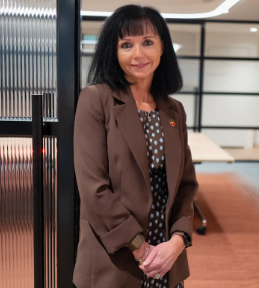 OzChild CEO, Dr Lisa Griffiths, has been named the winner of the Education, Government and Not-for-Profit category for the 2026 Financial Review Women in Leadership Awards. Selected from an exceptional field of finalists from across Australia, the award recognises women whose leadership is creating meaningful and lasting change within their organisations, industries and communities.
OzChild President Stephen Fontana said the award recognised a leader whose influence has extended far beyond organisational boundaries. “Lisa has dedicated her career to improving the lives of children, young people and families. She has challenged long-held assumptions, championed evidence-informed reform, and consistently advocated for approaches that deliver better outcomes for children. “This award recognises not only Lisa’s leadership, but the impact of her unwavering commitment to doing what works for Australian children and families.”
Congratulations Lisa!

Grant opportunity - National Service for Non-offending Family Members of Child Sexual Abuse Perpetrators
Applications are open for a three-year grant opportunity to establish Australia’s first national support service for non-offending family members of child sexual abuse perpetrators.
The grant opportunity will deliver a national service that provides non-offending family members support at the time of crisis and through ongoing periods of adjustment, recovery and healing. Non-offending family members will be able to access safe and inclusive support through a range of service channels, including a national helpline and an online peer support forum.
Applications are open on GrantConnect until to 3 July 2026. Further information, including the Grant Opportunity Guidelines, are available on the GrantConnect website.
Grant opportunity - Disaster Ready Fund Round Four 2026-27
Applications are open for the Disaster Ready Fund Round Four 2026-27.
The Disaster Ready Fund Round (DRF) is the Australian Government’s primary disaster resilience and risk reduction initiative.
Round Four of the DRF will build on previous rounds by providing up to $142.477 million for natural disaster risk reduction and resilience initiatives in 2026-27.
DRF Project Proposals must be submitted through state and territory Lead Agencies. Lead Agencies review all Project Proposals and shortlist applications for submission to the National Emergency Management Agency (NEMA).
Information about this grant opportunity, including grant opportunity documents, is available on GrantConnect.
AIFS 2026 Conference keynote speakers announced
 The AIFS 2026 Conference brings together four of Australia’s foremost thinkers and changemakers who are shaping national conversations on families, wellbeing, equity and social justice.
Professor Raymond Lovett AM – One of Australia’s most respected Indigenous epidemiologists, Professor Lovett leads the Mayi Kuwayu Study and is a leading authority on Aboriginal and Torres Strait Islander wellbeing. His work has directly informed national policy and strengthened Indigenous-led research at scale.
Honorary Professor Cathy Humphreys – A leading expert on domestic and family violence, Cathy’s work focuses on its intersections with mental health, substance use, and the experiences of children and young people, bridging research, policy and frontline practice.
Professor Leah Ruppanner – A prominent sociologist and founder of Lighten Lab, Leah examines how unpaid care, gender inequality and the mental load shape women’s lives, work and wellbeing, bringing research into everyday conversations through storytelling and media.
Reverend Tim Costello AO – One of Australia’s most recognised social justice advocates, Tim is a leading voice on gambling reform, poverty and inequality, with decades of leadership across national and international organisations.
Early bird tickets available until 30 June.

CHC81015 Graduate Diploma of Relationship Counselling – June 2026, Online
CHC81115 Graduate Diploma of Family Dispute Resolution – July 2026, Online
Couples Counselling Course: A contemporary and client-focused approach

NSW
Housing Support Workers | CatholicCare Wilcannia-Forbes
If you have any events you’d like listed on the FRSA Events and Training Calendar or job vacancies you’d like listed on the FRSA Jobs Board, email Communications Officer, Vanessa Lam at communications@frsa.org.au. Please note that posting onto the FRSA website is reserved for FRSA Members only.

Adverse childhood experiences, resilience and mental health in Australian men | Australian Institute of Family Studies
A new research snapshot from the Ten to Men: Australian Longitudinal Study on Male Health highlights the strong and lasting link between childhood adversity and adult mental health outcomes among Australian men. It finds that experiences such as emotional (34%) and physical abuse (38%) are common, and are consistently associated with higher rates of depression, anxiety and other mental health symptoms in adulthood, even after accounting for socio-economic factors. While resilience-supporting factors can reduce the impact of adverse childhood experiences, they do not fully offset the long-term effects. The findings underscore the importance of population-level prevention of childhood adversity as a key strategy for reducing adult mental ill-health.
Housing that Pays Back. Why Investing In Housing For Women And Families Delivers Measurable Economic Returns | YWCA Australia & Per Capita
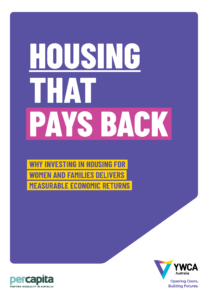 New economic modelling released by YWCA Australia and the Per Capita Centre for Equitable Housing shows that investment in long-term gender-responsive housing delivers strong economic and social returns, with every $1 invested generating between $2.02 and $4.66 in government savings and benefits. The analysis highlights significant reductions in health and justice system costs, alongside even stronger returns where housing supports family reunification. Framed as a high-return infrastructure investment, the findings argue that purpose-designed housing for women, gender-diverse people and families not only improves safety and stability but also delivers measurable fiscal benefits that exceed traditional infrastructure benchmarks.
Sexual Offending in Australia 2023-24| Australian Institute of Criminology
The Australian Sexual Offence Statistical collection brings together data on all types of sexual offending from across the country. This Statistical Report covers sexual offending proceeded against by police in all states and territories for the period 1 July 2023 to 30 June 2024. The report is provided with appendix tables.
Extreme weather impacts: research report exploring the impacts of extreme weather events on frontline staff across care and community services | Uniting Network
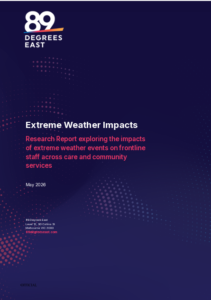 A 2026 survey of 829 frontline care and community service workers in the UnitingCare Network highlights the growing impact of extreme weather events -such as heatwaves, bushfires, floods, storms and cyclones – on both staff and service delivery. The findings show that the vast majority of workers are being directly affected, with many reporting heightened concern for the people they support and increased pressure to balance their own wellbeing with client needs during emergencies. Extreme weather is also disrupting service delivery, adding new responsibilities for staff, and contributing to negative impacts on the physical and mental health of both workers and clients. The report underscores the urgent need to better support and resource frontline services as climate-related risks intensify.
Left behind: systemic inquiry into responses to children and young people who are the subject of multiple reports to Child Protection | Commission for Children and Young People
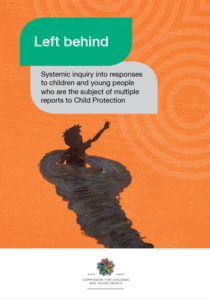 A new Victorian inquiry has highlighted significant gaps in support for children and young people whose safety and wellbeing concerns do not meet the threshold for statutory child protection intervention. The report found growing pressure on the child and family system, with family services funding meeting only around one-third of demand, and identified concerns that children’s needs and voices are not being consistently addressed. Key gaps include limited access to family violence services for children and young people.
Digital duty of care | ADM+S Centre
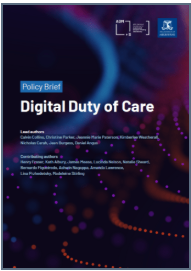 A new policy brief from the ARC Centre of Excellence for Automated Decision Making and Society (ADM+S) and the University of Melbourne’s Centre for Artificial Intelligence and Digital Ethics supports the Australian Government’s move to legislate a Digital Duty of Care for online services. It argues this reform should go beyond addressing individual harms to also tackle broader systemic risks such as inequality, discrimination and reduced access to information, with the aim of creating safer and more inclusive digital environments. The brief outlines two possible approaches – a risk-based model focused on harm prevention and an outcomes-based model focused on actively promoting safe and rights-respecting online spaces. It also stresses that strong accountability measures are essential, including improved transparency of algorithmic systems and the establishment of a national platform observatory to monitor platform behaviour and compliance.
Keeping the infant and toddler in mind | Emerging Minds
This free online course created by Emerging Minds aims to support practitioners working with families who have young children. It introduces a relationship-based framework that promotes the mental health of children from birth to age five, with a focus on the parent–child relationship. Check out this self-paced course today to increase your confidence in supporting parents to notice their child’s cues and nurture positive mental health.
Raising Children Up – Shutting Detention Down | ARACY
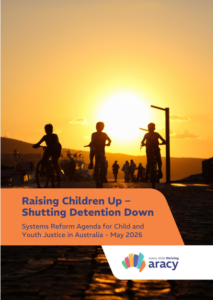 This report argues that improving child wellbeing is one of the most effective ways to create safer communities and reduce youth offending. Drawing on existing evidence and proven approaches, the paper calls for governments to shift investment from crisis response and detention towards prevention and early intervention. It combines The Nest Wellbeing Framework which identifies six conditions children need to thrive, with a Public Health Matrix that supports coordinated action across prevention, early intervention and tertiary responses.
Want to submit something to the FRSA eBulletin?
If you have an news item or event that you would like to be featured in a future eBulletin please submit your announcement via the form below or email communications@frsa.org.au with the subject “FRSA eBulletin submission”.
Please note FRSA members receive priority for items posted in the eBulletin. And to keep information current, relevant and useful, submissions will not be repeated from week to week.
Subscribe
Subscribe to receive future eBulletin editions directly to your inbox!