


No. 7, 2026 | 8 May 2026
Go to:
From FRSA's Executive Director
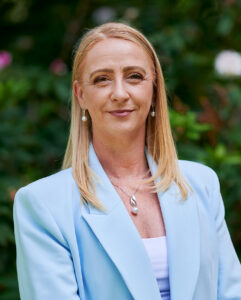
At the forefront of my mind this week is the prevalence of violence across our communities, particularly violence directed at women and at children. Wednesday this week (6 May) was National Domestic and Family Violence Remembrance Day – a day to remember and honour those killed due to family and domestic violence and show support for those experiencing family and domestic violence. I know that many of you would have participated in a candlelight vigil or paused to reflect on lives taken and clients, friends or family members impacted by family violence. Last night, vigils were held across the country to honour Kumanjayi Little Baby, who’s short life was so brutally ended at the hands of a violent man, and acknowledge the deep grief – and the love – of her family and community. This was an act of violence enabled, as Catherine Liddle CEO of SNAICC reflected, by “multiple system-level failures”. My heart goes out to all those who loved Kumanjayi little baby. As a society we need to get better at providing the systems and supports that enable families to keep safe. Of course, many of you are on the front line doing this important work, but more is needed and our governments must step up to the job.
The Federal Budget is just a few days away and I am hopeful we will see more to address violence – and to address poverty and homelessness. I’ll be in Budget Lockup on Tuesday evening and, as always, my team and I will deliver a Budget briefing to FRSA Members. This will be in your inbox on Wednesday morning. FRSA and our members were relieved to get advanced notification that family law services, funded through the Attorney-General’s Department, will be funded beyond June 2026 to end June 2028. This government commitment was looking shaky, and we are grateful that the government – as it faces tough fiscal challenges – has listened to sector concerns and recognised the value of this vital work. Family law services intervene early to prevent escalation into prolonged litigation, crisis accommodation, family violence and higher-cost justice system engagement.
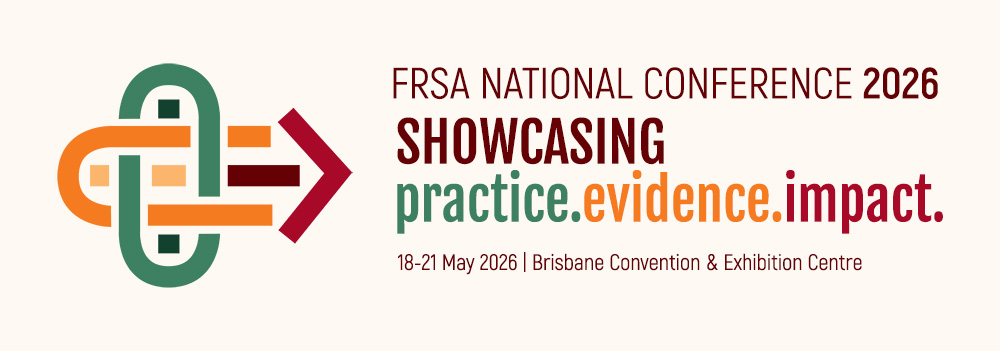
FRSA National Conference is just over a week away and we are getting very excited here in the FRSA Office. My team and I love the Conference and can’t wait to see you all! The Conference provides a fantastic opportunity for networking, sharing practice and learning. See more news below on our final keynote speakers. It’s not too late to register! We have just hit the 550 mark but there is always room for more!
Kind regards,
Jackie Brady
FRSA Executive Director



Final keynote announcements!
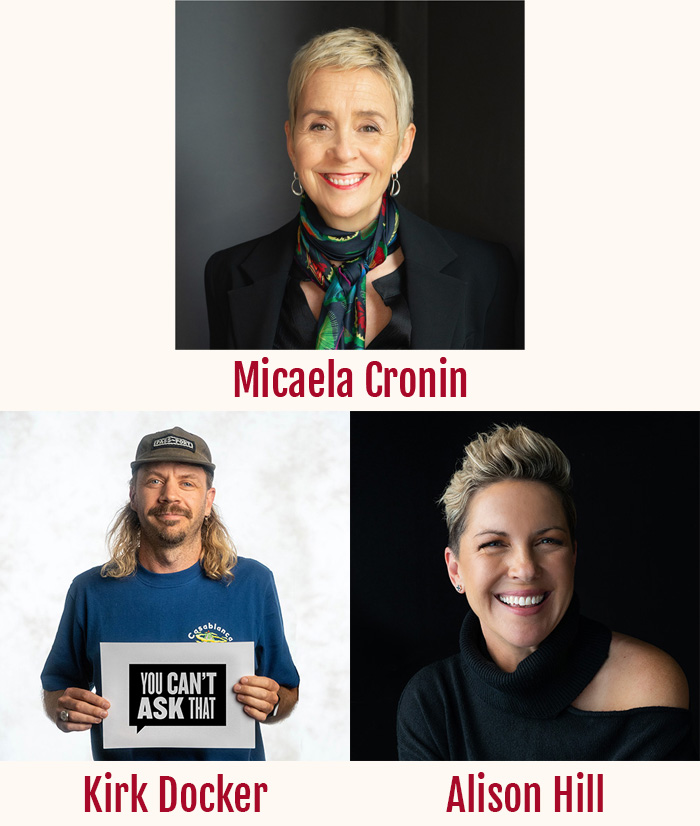
We are thrilled to announce our final three keynote speakers for the FRSA National Conference 2026.
Kirk Docker, Interviewer, TV producer & co-creator of the celebrated ABC program, You Can’t Ask That, will deliver a keynote address on Day one – The Art of Storytelling – deconstructing the barriers for effective dialogue.
Domestic, Family and Sexual Violence Commissioner, Micaela Cronin will deliver a keynote on Day two.
Alison Hill, registered psychologist, co-founder of three-time FR Fast 100 company, Pragmatic Thinking, and author of three best-selling books will deliver a closing address that promises to provide the skills to navigate ‘busyness’ and feel in control of things that truly matter. The timing couldn’t be better!
It’s not too late to register!
Yes – the FRSA Conference is just over a week away but it is not too late to Register!
Click here for Registration details – we will be taking registrations right up to Monday 18 May.
If you are registered and haven’t taken advantage of the pre-Conference workshops – don’t forget to check those out.
AND – if you are employed in a FRSA member organisation – you don’t need to attend Conference to access the on day pre-Conference Workshops and can still register.
We have on offer:
- Trauma and Healing Informed Care (First Nations focused workshop) delivered by Dr Carmen Cubillo, Healing Circle Mob
- Family Law Workshop – multiple presenters – check out the program
- Intersectionality in Practice – Build skill to work inclusively, safely and effectively with diverse and marginalised communities
- Structured approaches to practice improvement (AIFS workshop) – Embedding practice improvement and monitoring, evaluation & learning (MEL) for evidence-informed child and family services

Certainty for Family Law Services
FRSA was greatly relieved to hear that the Government has locked in a two-year funding extension for family law services, until end June 2028.
Family law services, which are funded under the Attorney-General’s Department Family Relationships Services Program, are frontline early intervention services that help families resolve separation safely, fairly and early, reducing conflict and diverting matters from the court system wherever possible.
Family law services bring key benefits for separating families: improved mental health and wellbeing, reduced violence and improved feelings of safety. Every dollar invested has a return on investment of $7.85.
We recognise the fiscal pressures facing the Government and are grateful that these vital services will be able to continue beyond June this year. Funding reductions would likely have shifted costs across government rather than reducing overall expenditure.
Unfortunately, the Government has made a decision to cease funding three programs:
- the Family Law Pathways Networks, which play a significant role in facilitating the networks and connections necessary to support clients in the Family Law System
- the First Nations Family Dispute Resolution Pilot, which will not be funded beyond the Pilot stage. Government is looking at other ways to support First Nations people and ACCOS to engage and operate in the Family Law system
- Court Network Support Services, which trains volunteers to support people in the court system. As we understand, Court Network Support Services will continue to receive some state funding.
More information about family law services is available on the Attorney-General’s Department website.
Relationships and Suicide Risk – new report
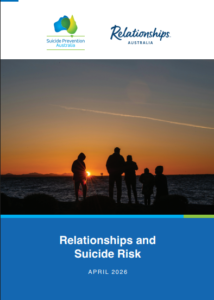 A new national report released by Suicide Prevention Australia in partnership with Relationships Australia is calling for shift in emphasis in how Australia approaches suicide prevention – placing relationships as a central focus of policy, services, and support.
Family and relationship stress impacts more than one in four Australians (27.5%), making it the second leading driver of distress, while 41% of people experiencing suicidal behaviour cite relationships breakdown as a key factor.
The report, Relationships and Suicide Risk, highlights the powerful role that relationships play in both protecting against and contributing to suicidal distress, and warns that current approaches remain too narrowly focused on crisis and clinical responses.
The report comprises:
- a scoping review of the research evidence
- identification of critical gaps and opportunities – the pathways for change
- actionable recommendations.
You can read more about the report here.
National Child and Family Investment Strategy released
 The Department of Social Services has released the National Child and Investment Strategy, which is a key activity of the Safe and Supported: Aboriginal and Torres Strait Islander First Action Plan 2023–2026.
The Investment Strategy recommends funding priorities for child and family services. It focuses on:
- shifting investment towards prevention and early support to reduce child abuse and neglect
- investing in Aboriginal Community-Controlled Organisations (ACCOs). This is to deliver an increased proportion of culturally appropriate child and family services.
You can read the National Child and Family Investment Strategy here. You can also access the Changing the Balance Report, which highlights how to support the sector as funding is shifted to Aboriginal Community-Controlled Organisation (ACCO) service delivery.
Early intervention for young people’s mental health – AIFS’ practice guide
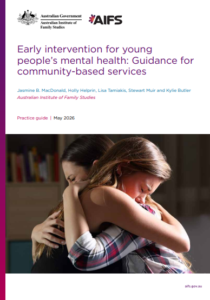 The Australian Institute of Family Studies (AIFS) has just published a new practice guide – Early intervention for young people’s mental health: Guidance for community-based services.
This resource presents a framework for understanding early intervention in community-based mental health supports for children and families. It covers the:
- difference between mental health and mental illness
- definitions of the main provision levels of early intervention (promotion, prevention, early identification and case management)
- challenges to providing early intervention supports.
The guide has been developed for practitioners working in Family Mental Health Support Services. It will also be useful to other practitioners working with children and young people, parents and families.
Community Attitudes Towards Poverty and Inequality – Report released
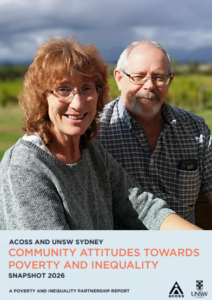 The Poverty and Inequality Partnership, which is headed by ACOSS and UNSW Sydney and supported by non-government organisation and philanthropic partners, has released its 28th report – Community attitudes towards poverty and inequality: snapshot 2026
The new research, which surveyed 2,520 people across the country, found:
- Three in four (74%) people reject the idea that people on JobSeeker deserve to live in poverty, up from 59% in 2023
- Three in four (74%) people agree that poverty is a big problem in Australia, up from 69% in 2023
- Less than a quarter (23%) said they could live on JobSeeker, currently $409 a week
- Three in five (60%) people agree that government policies have caused some people in Australia to experience poverty
- Almost nine in ten (87%) agree unemployment payments should be enough that people don’t have to skip meals
- Three quarters (76%) of people agree the gap between the wealthy and people experiencing poverty is too great, and 68% agree incomes at the top are too high
- Across the political spectrum, an average of 77% of voters agreed that poverty can be solved with the right systems and policies
- Support for action crosses party lines, with 86% of Greens voters, and 68% of Labor and Liberal/National voters agreeing that people who receive unemployment payments do not deserve to live in poverty.
This report is the second wave of this study and produced similar results to the initial survey which was reported in 2023. There was one major change in the second wave: 15% more people agreed with the statement that people who receive unemployment payments do not deserve to live in poverty.
Rental Affordability snapshot
 Anglicare Australia has released its annual Rental Affordability Snapshot, which shows that people on the lowest incomes have no access to the private rental market.
Every year, Anglicare Australia surveys rental listings across Australia to see what it is like for people on low incomes to rent a home. The Rental Affordability Snapshot is released every year in April. This is the seventeenth edition.
The Snapshot surveyed nearly 49,000 rental listings across Australia and found that:
- Just 1 rental (0%) nationwide was affordable for a person on JobSeeker
- 0 rentals (0%) were affordable for a person on Youth Allowance
- Just 0.2% of rentals were affordable for a single person on the Age Pension
- A full-time minimum wage worker could afford just 0.5% of listings
- Even a couple with two minimum wage incomes could afford only 14.8% of rentals.
Anglicare Australia Executive Director Kasy Chambers said the results show a system that is failing ordinary Australians. She said, “The only way to fix this is for governments to step back in by building public and community housing and rebalancing the system. In the next Budget, the Government has a real opportunity to reset the system by winding back unfair tax breaks and investing in the homes Australia actually needs.”
The National Report – 2026: Rental Affordability Snapshot – and 2026 Regional Reports are available on the Anglicare Australia website.
Next steps to strengthen safety in child care
The Albanese Government has announced the next steps it will take to strengthen safety in child care, working with States and Territories to consider the development of a national Early Education and Care Commission.
Minister for Education, the Hon Jason Clare MP, said this will be a priority when Education Ministers next meet in July.
Establishment of a commission was recommended by the Productivity Commission in its 2024 inquiry report outlining a path to universal early childhood education and care.
National Healthy Men Community Conversations launched
On 6 May 2026 the Albanese Government launched the National Healthy Men Community Conversations project to support the health and wellbeing of men and boys.
The project will deliver a series of community conversations across the country, bringing together the public and organisations working to support men’s health and wellbeing, as well as those engaged in family, domestic and sexual violence prevention.
The project aims to explore and encourage help-seeking and connection for mental, physical and social wellbeing and health among men.
Assistant Minister for Social Services and the Prevention of Family Violence, Ged Kearney, and the Special Envoy for Men’s Health, Dan Repacholi will lead the project.
The Government is also extending funding for the Healthy Masculinities Trial and Evaluation Program (Healthy MaTE) through to 30 June 2027.
General Social Survey: Summary Results 2025
The Australian Bureau of Statistics (ABS) has released the latest General Social Survey Summary Results, Australia. The survey results provide data on the social characteristics, wellbeing and social experiences of people in Australia.
Key statistics
Of Australians aged 15 years and over in 2025:
- overall life satisfaction was 7.1 out of 10, similar to 2020 (7.2), but lower than 2019 (7.5) and 2014 (7.6)
- just under a quarter did unpaid voluntary work through an organisation (23%), similar to 2020 (25%), but down from 30% in 2019
- 53% had weekly in-person contact with family or friends living outside their household, more than in 2020 (42%), but less than 2019 (68%)
- 75% agreed that it is good for society to be made up of different cultures, down from 85% in 2020 and 81% in 2019
- 50% agreed that most people can be trusted, down from 61% in 2020 and 55% in 2019
- 25% of households had at least one cash flow problem, up from 21% in 2020 and 22% in 2019.
Data from this survey will be used to update some metrics in the Measuring What Matters Framework on an annual basis, starting from the 2026 dashboard update.

National Directory of Services for people who use violence - Sector Launch
 It’s not too late to register for the National Directory of Services for people who use violence sector launch, which will be hosted by the Men’s Referral Service, No To Violence.
Held in-person and online, this launch will introduce the new directory and explore how it can support the Domestic and Family Violence sector and other professionals in their efforts to end family violence and build safer communities.
- Thursday, 14 May 2026
- Online 3pm – 4.45pm or
- Melbourne in-person 3pm – 6pm, with post event networking.
For information about speakers and to register, click here.
PLACE Scholarships Program 2026
 PLACE – Partnerships for Local Action & Community Empowerment – is calling on anyone working or volunteering in place-based work to apply for PLACE’s scholarship program before it closes on 18 May.
PLACE’s scholarship program addresses barriers to accessing quality training for place-based work – including location, cost, time commitment, and assumed skills – allowing practitioners to complete training and increase their capability for systems change.
To find out more about the program, please visit the PLACE website for information on how to apply.
Survey - National Mental Health and Suicide Prevention Agreement
 The National Mental Health Consumer Alliance (NMHCA) is inviting people with lived experience of mental health challenges to share whether the current National Mental Health and Suicide Prevention Agreement has delivered safe, effective, available mental health services and supports.

CHC81015 Graduate Diploma of Relationship Counselling – June 2026, Online
CHC81115 Graduate Diploma of Family Dispute Resolution – July 2026, Online
Couples Counselling Course: A contemporary and client-focused approach

NSW
Support Workers (Education, Engagement & Attainment) | CatholicCare Wilcannia-Forbes
Coordinator (Education, Engagement & Attainment) | CatholicCare Wilcannia-Forbes
SA
FAMILY DISPUTE RESOLUTION PRACTITIONER (Qualified or Trainee) | Centacare Catholic Country SA
VIC
Family Dispute Resolution Practitioner | Mallee Family Care
If you have any events you’d like listed on the FRSA Events and Training Calendar or job vacancies you’d like listed on the FRSA Jobs Board, email Communications Officer, Vanessa Lam at communications@frsa.org.au. Please note that posting onto the FRSA website is reserved for FRSA Members only.

Supporting LGBTQ+ young people with disability: What service providers need to know | Australian Insitute of Family Studies
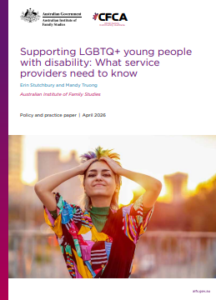 This resource is aimed at practitioners, service providers and other professionals who work with young people with disability and/or LGBTQ+ young people.
The resource covers:
- what intersectionality is and why it’s important when it comes to LGBTQ+ young people with disability
- what the research says about the key issues experienced by LGBTQ+ young people with disability
- practice considerations for better supporting the wellbeing and needs of LGBTQ+ young people with disability.
Positive use guide: evidence-based insights on the impact of digital devices on child and adolescent wellbeing | Centre for Evidence and Implementation
 This guide provides evidence-based practical tips and checklists on how to manage screen time for children and adolescents in Singapore to help them build a normalised, lifelong relationship with technology. The guide discusses how screen use has both positive and negative effects. It finds screen use has a less significant role in wellbeing than other factors.
Australian Human Rights Assessment report card 2026 | Australian Human Rights Commission
In this inaugural annual assessment of Australia’s contemporary human rights record, the Australian Human Rights Commission provides an evaluation of how well Australia is protecting people’s human rights.
State of the housing system: 2026 | National Housing Supply and Affordability Council
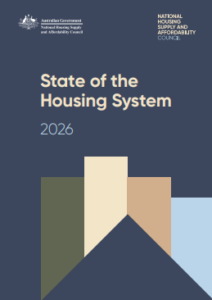 This report provides an independent assessment of current housing system conditions in Australia and the factors shaping outcomes for households. It brings together data, analysis and stakeholder insights to support informed decision-making and to identify where policy settings can be strengthened to improve supply, affordability and access. Six priority areas for housing reform are outlined.
Understanding identity exploration among LGBTQ+ young people with disability | Australian Institute of Family Studies
This resource describes some of the experiences of LGBTQ+ young people with disability and the importance of identity exploration and formation for their wellbeing. It highlights what service providers should be aware of when working with these young people to ensure services are inclusive and supportive. It also includes practice considerations that will help ensure services better meet the needs of all young people – irrespective of their gender, sexuality or disability.
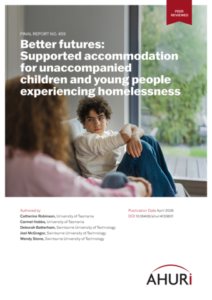 This research project examines the effectiveness of Australia’s supported accommodation services in meeting the needs of unaccompanied children and young people aged 12–24. It proposes principles to guide policy and practice toward a better system.
The state of multicultural mental health in Australia: Research report | Western Sydney University
 This report examines the extent to which mental health policy intent, legal obligations and fundamental principles are being realised in practice. It provides a snapshot of how well Australia’s mental health system is supporting multicultural communities – and where gaps remain. It also identifies examples of emerging good practice with the potential to be adopted at scale and contribute to the realisation of policy objectives.
Making Place Matter: Who decides? | PLACE
 The first series of this new podcast from PLACE explores shared decision-making across six episodes, hosted by Gamilaroi woman and journalist Brooke Boney. Episode 1 opens in Millgrove, Victoria, where the Millgrove Residents Action Group has built a community where people’s voices genuinely shape what happens next. Across the series, guests include Children’s Ground, Learning the Macleay, Millgrove Residents Action Group, SNAICC, Brotherhood of St. Laurence, Minderoo Foundation, Greater Shepparton Lighthouse Project, the Productivity Commission and more. New episodes drop weekly through to 10 June.
Forces at work: adult learning and the Australian labour market | Jobs and Skills Australia
 Jobs and Skills Australia’s latest working paper explores how major economic forces are transforming the way Australians develop skills across their working lives. From rapid technological change to an ageing workforce, the paper highlights why lifelong learning is becoming essential for individuals, employers and the broader economy.
Want to submit something to the FRSA eBulletin?
If you have an news item or event that you would like to be featured in a future eBulletin please submit your announcement via the form below or email communications@frsa.org.au with the subject “FRSA eBulletin submission”.
Please note FRSA members receive priority for items posted in the eBulletin. And to keep information current, relevant and useful, submissions will not be repeated from week to week.
Subscribe
Subscribe to receive future eBulletin editions directly to your inbox!
