


No. 1, 2026 | 2 February 2026
Go to:
From FRSA's Executive Director
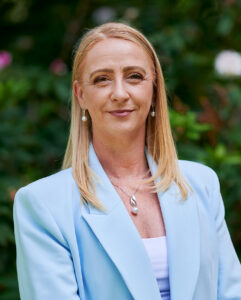
I know there is a bit of a debate as to how far into the new year you can actually wish someone a HNY – but as this is our first e-bulletin for 2026 – I will take the liberty of wishing all our readers a Happy New Year!
Here at FRSA we have been busily preparing for the year ahead.
Whilst everyone is active with their ‘Business as usual’ activities, lingering in the background of course are the unresolved matters around the future of services for children, families and communities. Spending some time over the break reading submissions in response to the Government’s consultation process, it is clear there is significant agreement and resonance from those making submissions with the Government’s proposed reform of the Families and Children’s Activity. Whilst we wait for the Government’s decision, what we do know is there will be a grant round for DSS funded programs. Whilst we know it can’t be too far away – I don’t have any clarity around dates and timelines at this stage (although I have asked).
I know we also await any further advice regarding the Government’s response to the Metcalfe Review and any reform in the Family Law sector and services – but that too is a ‘watch this space’ in what I believe will be a longer timeframe.
A few key FRSA dates to have on your radar are the:
FRSA Conference, 18-21 May 2026 in Brisbane
The FRSA Conference program is close to being finalised. We aim to have that out to the sector in the next two weeks.
Strategic Leadership Forum, 16- 17 September in Canberra
Just noting this event will be held in September again this year.
I also wanted to highlight that our Communities of Practice for DSS and AGD funded programs will start up again in mid-February this year. There is space for new participants in some of those CoP groups so, if you are involved in delivering programs under the DSS FaC Activity or the AGD FRSP program and interested – please don’t hesitate to reach out to either Rhys Jaconley or Lisa Curtis (contacts below)
With 2026 well underway, just a reminder that the FRSA team is here to assist you. Please don’t hesitate to get in touch:
- Jackie Brady, Executive Director – ExecDirector@frsa.org.au
- Robyn Clough, Manager, Policy and Research – policy@frsa.org.au
- Lisa Curtis, Policy and Projects Officer – projects@frsa.org.au
- Rhys Jaconley, Project Officer – Family Law Communities of Practice – FLProjects@frsa.org.au
- Narelle Kay, Events and Membership Officer – events@frsa.org.au
- Vanessa Lam, Communications Officer – communications@frsa.org.au
- Heidi Aynsley, Administrative Officer – admin@frsa.org.au
Or contact the National Office on 02 6162 1811.
Kind regards,
Jackie Brady
FRSA Executive Director



Early bird registration rates available!
Reminder that Early Bird registrations are open! Don’t miss out on saving up to $200 per person with rates ending Monday, 2 March 2026.
Early Bird Registration Fee* Until 2 March 2026
| Member Rates | Non-Member Rates | |
| Complete Conference Experience – Including dinner | $1,125.00 | $1,425.00 |
| Conference Only – No dinner | $1,050.00 | $1,350.00 |
* To be entitled to the early bird registration fee you must have registered and paid by 9 March 2026.
Group Registrations
FRSA is pleased to offer FRSA Members the opportunity to register five (5) participants and receive the sixth registration complimentary. To be eligible for the complimentary registration, you must register your five (5) participants using the link below. Instructions on how to register your complimentary registration will be provided on the confirmation email. Interested in becoming an FRSA Member? Visit our Membership page.
Please note: When registering the 6 for 5, to receive the 6th registration free the same registration type must be purchased for the entire group.
2026 Conference Prospectus
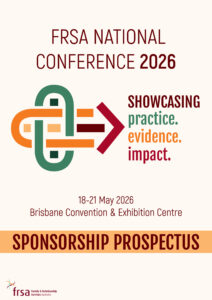 Sponsorship has always been a big part of FRSA’s Conferences and in acknowledgement of this support, we have designed packages that will allow for maximum visibility to showcase the work and activity of your organisation/business. See our Conference Sponsorship Prospectus below for more details.
This year’s Conference is expected to attract 600+ delegates, including practitioners, researchers, managers, executives, and policy and program developers from government and non-government agencies.
We welcome your support of the Conference and hope that you will take advantage of the opportunities available to you in joining with FRSA as a Conference 2026 sponsor. There are still a number of sponsorship package options available, designed to maximise visibility to showcase the work and activity of your organisation/business. Or if you are interested in a more bespoke package for your organisation don’t hesitate to get in touch with the FRSA team on (02) 6162 1811 or events@frsa.org.au.
Bursary Program
We have four bursaries available for Aboriginal and Torres Strait Islander people who are registered for or would like to attend the 2026 Family & Relationship Services Australia National Conference.
Bursaries are provided to assist with covering the cost of conference registration, and travel & accommodation. To be eligible you must be an employee of a fully financial FRSA member organisation. Each package includes:
- 1 x complimentary full registration to the Conference (including dinner)
- $500 towards travel and accommodation
Applications close on FRIDAY, 27 March 2026. Please note, this Bursary Program is open to people who are yet to register and those who are already registered.

Australia Day Honours
 FRSA congratulates former National Children’s Commissioner, Anne Hollonds on recieving an Officer of the Order of Australia (AO) for her distinguished service to family, children and community safety, wellbeing and human rights, and to policy, research and practice.
As a former CEO in the Family & Relationship Services Sector, Anne has always taken her unique experience of this sector and the work we do with our children, families and communities into the various conversations she has been involved in. FRSA has always been extremely grateful to Anne for her engagement with us and with our network. We have been fortunate to have Anne speak at numerous FRSA events and her passion for work is compelling and infectious. It was lovely to see her lifetime of commitment to improving the life circumstances for children, their families and the communities around them acknowledged in the Australia Day awards.
Social connections and better mental health in older Australians
Research from the Centre for Healthy Brain Ageing (CHeBA) at UNSW Sydney has found that staying connected with friends, neighbours and the community may help protect older adults against depression.
Using data from CHeBA’s Older Australian Twins Study (OATS), one of Australia’s most comprehensive ageing research projects, researchers analysed more than 560 twins aged 65 and over across six years to understand how social connections relate to mental and cognitive health.
The three types of social connections that were identified were: spending time with friends, neighbours and the community; interacting with family or providing childcare; and participation in religious groups. All three social connection types were weakly heritable, indicating strong environmental influence. This means that the individual’s experiences and environment largely influence social connections and therefore social engagement can be boosted. The study found that even modest increases in social interaction had measurable benefits.
With a rapidly ageing population the research strengthens the case for community programs that support older Australians.
The study has been published in the British Journal of Psychiatry.
Banks and lenders unite to fight financial abuse
Australia’s banks and finance firms have come together with Australia’s leading financial safety by design expert, to prevent financial abuse, with the launch of the Financial Safety Alliance.
The Alliance will provide lenders with the tools to integrate financial safety by design principles into their products and services to minimise the weaponisation of financial products and give victim-survivors the support they need.
This alliance builds on the work of 40 banks who have updated their terms and conditions to ban the misuse of financial products for control or harm, putting more than 20 million customers on notice that financial abuse carries serious consequences.
2025 Population Statement released
Federal Treasurer Jim Chalmers recently released the 2025 Population Statement, which is produced by the Australian Government Centre for Population.
Key findings include:
- Population growth:
- Australia’s population passed 27.5 million in 2025. By 2035–36, it is projected to grow to 31.5 million.
- Population growth is expected to slow to 1.3% in 2025–26. This largely reflects falling net overseas migration and fertility rates.
- Migration trends:
- Net overseas migration has fallen since its peak in 2022–23. Fewer temporary migrants, particularly on student and visitor visas, are arriving.
- Migration is returning to pre-COVID-19 pandemic patterns.
- In 2025–26, net overseas migration is forecast to be 260,000.
- Fertility rates:
- In 2025–26, the total fertility rate is expected to fall to a record low of 1.42 children per woman, well below the replacement level of 2.1.
The Population Statement also includes state and territory, capital city and regional projections. Capital cities are projected to grow nearly twice as fast as rest-of-state areas. Western Australia is expected to be Australia’s fastest growing state or territory in the coming years, while Tasmania will remain the slowest growing.
The Statement and population projections are available on the Centre for Population website.
9.7 million Australians starting 2026 in debt
New research from The Salvation Army reveals that more than 9.7 million Australians (44%) will start 2026 in debt and almost nine in ten (89%) feel the same or more stressed about their finances than last year.
The Salvos’ national survey of 2,005 people found:
- 45% feel pressure to spend more than they can afford. Of those, 43% say embarrassment about their financial situation drives that pressure and 31% cite cultural or societal expectations
- 24% find it difficult to create a budget
- 20% struggle to prepare a tax return
- Among those starting 2026 in debt, 52% have credit card debt and 26% have Buy Now, Pay Later debt
- 23% never speak to family or friends about their financial situation
- 32% feel uncomfortable discussing money at all with their family or friends
UN urges Australia to raise age of criminal responsibility
A major United Nations review of Australia’s human rights record has urged Australia to raise the age of criminal responsibility, with children as young as 10 able to be arrested, prosecuted and jailed in some Australian jurisdictions and First Nations children disproportionately impacted.
Australia was reviewed by the UN Human Rights Council in Geneva under the Universal Periodic Review (UPR), a five yearly peer review process where members assess each state’s human rights performance and make recommendations for reform.
UN countries also called for a national Human Rights Act in Australia to better protect people’s rights and the review flagged persistent concerns about racism and Indigenous justice, alongside progress on gender equality.
You can read the Australian Human Rights Commission media release about the review here.

Report on Government Services 2026 released
The Productivity Commission has released the 2026 Report on Government Services. The report provides data directly from all Australian governments on the equity, efficiency and effectiveness of the services they provide. These services include schools; police, courts and corrective services; health services; aged care and disability services; and housing and homelessness services. Government expenditure on these services was approximately $412 billion for 2023-24 – around 70% of government recurrent expenditure.
- Approach to performance reporting (part A)
- Community services (part F)
- Housing and homelessness (part G)
Upcoming release schedule:
- Tuesday 3 February 2026 – Justice (part C) and Emergency management (part D)
- Thursday 5 February 2026 – Health (part E)
- Tuesday 10 February 2026 – Child care, education and training (part B)
For further information on this year’s edition, please visit the report page: www.pc.gov.au/ongoing/report-on-government-services/

Interrelate launches new branding
 Last month Interrelate launched their new branding and tagline; The foundation of healthy relationships.
About the branding Interrelate said, “As we begin our 100th year of service to the Australian community, Interrelate has launched a renewed brand that builds on the strengths that have defined our organisation for a century. This was not about reinvention, but an evolution. As our capability, reach and influence have grown, our previous identity no longer fully reflected the professionalism, warmth and guiding role that characterise our work today. The new brand honours our history while positioning Interrelate for the future, strengthening recognition and understanding of who we are across the sector. ”
“At the heart of the new brand is a clear and enduring purpose: to support healthy human connection from childhood. This reflects what Interrelate has always stood for; being inclusive, accessible and walking alongside people with education and therapeutic support that strengthens lives. Our brand idea, Interrelate is the foundation of healthy relationships, positions us as a trusted partner to families, communities, government and sector colleagues. This is reinforced through our new colours: deep purple, representing trust, steadiness and care, and yellow, expressing optimism, empowerment and possibility, together they signal a stable foundation that helps people move forward. “
Wendy Field departs The Smith Family
 Wendy Field concluded her time at The Smith Family at the end of December 2025, after more than 15 years with the organisation. Wendy most recently held the role of Head of Evidence and Impact and has now commenced doctoral studies at Queensland University of Technology.
Suzie Riddell has stepped into the role, bringing extensive experience from her previous position as CEO of Social Ventures Australia.
FRSA thanks Wendy for her significant contribution and wishes her every success in her future studies. We look forward to working with Suzie in her new role.
CatholicCare Sydney welcomes new CEO
 Earlier this month CatholicCare Sydney announced the appointment of Richard Timbs as their new Chief Executive Officer.
Richard brings more than 20 years of senior leadership experience across government, corporate, and not-for-profit sectors, with a strong track record in leading complex reform and delivering community-centred outcomes. His career includes senior roles at S&P Global Ratings and the NSW Government, where he oversaw major reforms and transactions impacting community services.
Richard commenced in the role on 9 January 2026 taking over from Acting CEO, Kate Dover, who will transition to Deputy CEO.
FRSA congratulates Richard on his new role and looks forward to working together in the future.

ARACY Announces New CEO: Melodie Potts Rosevear OAM
 ARACY has appointed Melodie Potts Rosevear OAM as its new CEO, commencing 9 February 2026, following a comprehensive recruitment process.
She succeeds Prue Warrilow, who is acknowledged for significant organisational reforms and strengthening ARACY’s foundations. Melodie plans to build on ARACY’s strong reputation for evidence-driven action, strengthening partnerships, and scaling prevention and early intervention initiatives shaped by research and young people’s voices.

SCHADS Award Review – Have Your Say
The Fair Work Commission is reviewing the SCHADS Industry Award to address gender-based undervaluation in the sector. An Alternative Award Structure was released in December 2025 following sustained advocacy from unions and the COSS Network, representing an improvement on the earlier provisional model.
Key improvements include stronger protection against pay reductions and new classification definitions that better recognise industry experience and lived experience.
Another round of consultation is now open, and organisations are encouraged to provide feedback to ensure the final award is fair, practical and fit for purpose.
Priority feedback areas include pay protection, role classifications, recognition of qualifications and experience, and operational impacts for services.
Submissions close 5pm (AEDT) 6 February 2026
Submissions should be lodged by email to awards@fwc.gov.au.
National Reconciliation Week 2026 theme announced
 Reconciliation Australia has announced that the theme for National Reconciliation Week 2026 is All In, a call for all Australians to commit wholeheartedly to reconciliation every single day.
In the announcement they said the theme, “All In makes clear that reconciliation is not a spectator sport, and that all of us must step away from the sidelines and take action to make change.
The theme also reminds us that reconciliation and advancing Aboriginal and Torres Strait Islander peoples’ rights isn’t a passive activity, and it is not solely the responsibility of First Nations people, who have carried the weight of championing, explaining and acting for far too long.”
National Reconciliation Week – 27 May to 3 June every year – is a time for all Australians to learn about our shared histories, cultures, and achievements, and to recommit ourselves to reconciliation and the fight for First Nations justice in Australia.
The #NRW2026 campaign was created in collaboration with Carbon Creative, a First Nations-owned and operated marketing and creative agency. The 2026 artwork is by renowned Gumbaynggirr/Bundjalung artist Otis Hope Carey.
Find out more or download resources via the Reconcilation Australia website.
Call for abstracts open for AIFS Conference 2026
 The 18th biennial AIFS Conference will be held from 9–11 September 2026 in Melbourne, bringing together government, practitioners and researchers to explore how policies and systems can better support diverse families in a changing world.
Under the theme Changing Families in Changing Times, the conference will showcase evidence-driven insights and promote cross-sector dialogue through keynotes, panels and symposia. Abstract submissions are open from 19 January to 27 February 2026, and early bird registrations open in April 2026. For more information visit their website.
NFP Remuneration Survey
 Pro Bono Australia’s 14th annual Salary Survey is open. Strong participation from across the sector is critical in order to benchmark and analyse trends in salaries from year to year.
The results will provide invaluable feedback and information and assist in compiling the report analysing salary levels, expectations and employment trends for the not-for-profit sector in Australia.
As a thank you for completing the survey in full, you can access 50% off the 2026 Salary Survey report, as well as go in the draw to win $500 donated to the charity of your choice.
All responses will be kept strictly confidential. Submissions close 5 March 2026. Click here to complete the survey.
Safer Internet Day
 Safer Internet Day is coming up on 10 February 2026. The day is a global day of action dedicated to raising awareness of online safety.
eSafety Commissioner has put together a Safer Internet Day hub including resources, ideas and downloads to help you run activities and show your support for a safer, more positive internet.

CHC81015 Graduate Diploma of Relationship Counselling – June 2026, Online
CHC81115 Graduate Diploma of Family Dispute Resolution – July 2026, Online
Couples Counselling Course: A contemporary and client-focused approach

VIC
Family Dispute Resolution Practitioner (FDRP) | Mallee Family Care
Team Leader (Family & Carer Services) | Each
TAS
Practice Manager: Inspire at Home | CatholicCare Tasmania
Family Programs Statewide Manager | CatholicCare Tasmania
If you have any events you’d like listed on the FRSA Events and Training Calendar or job vacancies you’d like listed on the FRSA Jobs Board, email Communications Officer, Vanessa Lam at communications@frsa.org.au. Please note that posting onto the FRSA website is reserved for FRSA Members only.

Key questions for AI in public institutions | ARC Centre of Excellence for Automated Decision-Making and Society
 This report explores how corporate Artificial Intelligence (AI) impacts institutions serving the public good, focusing on universities and social services. It invites reflection and critical questioning through thought provoking prompts. Designed to spark dialogue, advocacy and policy engagement, it offers resources that encourage deeper exploration of AI’s role through a Data Justice lens.
Entangled: the couple rule, domestic violence and women’s economic security | Brotherhood of St Laurence
 The report examines how Australia’s social security “couple rule” — which assesses income support based on relationship status — reduces financial support for people in relationships by treating their finances jointly. This rule assumes couples share resources, but in practice it can leave women financially insecure and vulnerable to economic abuse, especially if they are trying to leave violent or controlling partners. The research finds that the rule can trap women in abusive relationships, create barriers to training and independence, deepen debt, and reinforce gender inequality. It calls for reforms that treat single and partnered adults equally, improve support for victim-survivors, and recognise the wider impacts on women’s economic security.
Gambling with money you don’t have: understanding the interaction between credit cards and sports gambling | e61 Institute
In June 2024, the Australian government banned the use of credit cards for online gambling. Using transaction data, this research note evaluates the policy’s effect. The focus is on its impact on online sports gambling. The note finds if policy is to reduce gambling harms, greater returns may come from targeting other forms of gambling.
Inquiry into elder abuse in Queensland | Education, Arts and Communities Committee (Qld)
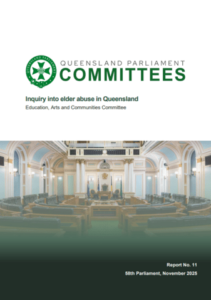 This report presents a summary of a Queensland inquiry into elder abuse. The inquiry considered the nature and extent of elder abuse, the effectiveness and cohesiveness of responses to elder abuse and opportunities to improve responses to elder abuse within the government, broader community, non-government and private sectors. The report provides 16 recommendations.
Share the care | Relationships Australia
 ‘Share the care’ is one of Relationships Australia’s most-used resources, providing current, practical advice and templates to help separating co-parents draw up a parenting plan while focusing on their children’s best interests.
Over the years, clients have shared how this booklet helped them to think more deeply about the process of co-parenting, gave them a framework to build upon, and made aspects of managing their recent separation a bit easier for both them and their children.
Racism and the health and wellbeing of Aboriginal and Torres Strait Islander children | Lowitja Institute
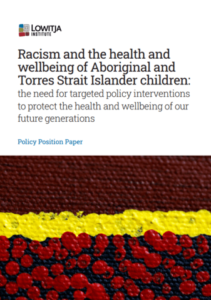 This position paper reviews current policies focused on racism and health and examines how well these are addressing the unique and catastrophic impacts that racism has on Aboriginal and Torres Strait Islander children’s health. It calls for urgent action to support local, community-led responses and drive systemic reform to protect and promote their wellbeing.
Understanding why some Autistic children use potentially harmful behaviours | Australian Institute of Family Studies
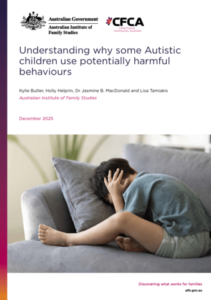 This guide summarises evidence on potentially harmful behaviours (PHB) in Autistic children, showing how PHB may communicate unmet needs linked to neurodevelopmental differences. The guide is for practitioners working with children and young people, parents and families and has been developed specifically for practitioners who have less than 5 years of experience in the child and family services sector.
Understanding public awareness of BetStop in Australia | Australian Insitute of Family Studies
BetStop is one of the Australian Government’s key policy responses to mitigate online gambling harms. However, this study has found that awareness of the initiative, which has been in place for around 2 years, is low relative to the rise in online gambling participation and harm.
Australia’s multi provider social housing system: contest or growth? | Australian Housing and Urban Research Institute
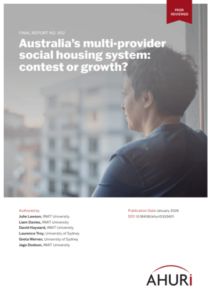 This research examined Australia’s multi-provider social housing system and analysed changes over time to social housing delivery. It finds Australia lacks long-term, sustainable social housing growth models and the report offers policymakers options to reverse the decline.
Want to submit something to the FRSA eBulletin?
If you have an news item or event that you would like to be featured in a future eBulletin please submit your announcement via the form below or email communications@frsa.org.au with the subject “FRSA eBulletin submission”.
Please note FRSA members receive priority for items posted in the eBulletin. And to keep information current, relevant and useful, submissions will not be repeated from week to week.
Subscribe
Subscribe to receive future eBulletin editions directly to your inbox!
