


No. 14, 2026 | 4 September 2026
Go to:
From FRSA's Executive Director
With the imminent release of the DSS Children and Family Support Program Grant Guidelines (scheduled 18 September), the department has been busy preparing the groundwork for launch day. This has included release of the Provider Previews for organisations eligible to apply and other related documentation. There is also a lot of activity going on in locations where a Stronger People Stronger Places and/or Empowered Communities backbone organisations are situated, with Partnership Tables being convened in very short timeframes. There is a significant amount of information that existing FAC funded program holders are digesting as they prepare for the re-commissioning process.
Two key points I would like to bring to your attention:
- If you are currently funded by DSS to deliver FaC programs and are involved in this process, I would like to remind eligible members that you MUST apply to the recommission process. This is not a contract rollover process. You will need to apply through the Grant Opportunity to be considered for recommissioning.
- I encourage you to use the DSS Frequently Asked Questions as a repository of information to refer to and draw from (see more below). If you do not find the answers you are looking for, please don’t hesitate to contact your Funding Agreement Manager at FamilyWellbeing.Manager@CommunityGrants.gov.au (you may also have more direct contact details you may wish to use.) Importantly, the DSS national office is actively working to keep abreast of issues and questions that are arising and it would be useful to reinforce with your FaM the benefit of ensuring your grassroots messaging is making it through to the Canberra office.
We too are experiencing high volumes of engagement with members across a broad range of issues regarding the upcoming grant round and process. I am delighted that the Secretary of the Department of Social Services, Mr Michael Lye, and two key team members involved in this work – Jacqueline Hrast, Group Manager, Family Wellbeing; and Kath Paton, Group Manager, Community Grants Hub – will be speaking as part of the program at the upcoming Member Only FRSA Strategic Leadership Forum on 16 September 2026. We have around 80 people registered for the Strategic Leadership Forum and registrations are still open if you would like to attend.
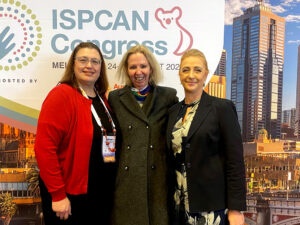
Last week, I attended the ISPCAN International Congress that was held in Melbourne joining with around 1200 delegates who were there, including a couple of FRSA Board Directors! It was great to see and chat with FRSA members in attendance as well as meet new people working to achieve better outcomes for our children in Australia. With a particular emphasis on Child Protection, the Congress is a well-established event on the international calendar. My sincere congratulations to CEO of the Australian Childhood Foundation, Janise Mitchell, for her role in pulling together this great event. There was an amazing array of choice when it came to learning opportunities and experience and I gained a renewed appreciation of just how valuable it is to take the time to be present and engaged at these events as a delegate.
Just a reminder a few of us will be at the Australian Institute of Family Studies (AIFS) Conference next week. Robyn and I will be presenting on our FRSA Mapping Intervention Report on Wednesday. We also have an exhibition booth and hope you can pop past and say hello – Vanessa and Lisa will be there too. We are all looking forward to seeing many of our members who we know will be in attendance.
Sadly, it will be the last external event that Lisa will be attending as a member of FRSA’s staff team. Unfortunately, she will be leaving FRSA at the end of September – the 25th – and if you know and have met Lisa, you know how missed she will be. Lisa has been responsible for running the DSS Program Communities of Practice and I am actively working in the hopes that we can find someone with the appropriate skills and qualification to take on that part-time role. You can find out more about it on the FRSA Jobs Board.
It really has been a mammoth couple of weeks but before I sign off and encourage you to read the rest of the eBulletin, just a heads up for our members that we opened up the FRSA Board nomination process on 2 September. We do have two Member Elected Board Director places that we will need to fill ahead of the FRSA AGM on 25 November 2026 – and this process is in play. It should have landed with our FRSA Member delegates (via email) but if you have not seen it, please contact Heidi in our office on 02 6162 1811 or admin@frsa.org.au.
Kind regards,
Jackie Brady
FRSA Executive Director



Domestic, Family and Sexual Violence Advisory Council
The Government has announced appointments to the newly established Domestic, Family and Sexual Violence Advisory Council.
The Council will work with the Australian Government on the development, implementation and monitoring of action plans under the National Plan to End Violence against Women and Children 2022–2032 (National Plan).
The Council brings together expertise from across the domestic, family and sexual violence sector, research, community organisations, lived experience, business, service delivery and related fields to provide advice on emerging issues, priorities, evidence and opportunities to strengthen national efforts to prevent and respond to violence.
The 14 Council members are:
- Kate Alexander
- Muriel Bamblett AO
- Hayley Boxall
- Leah Bromfield
- Tarang Chawla
- Chanel Contos
- Karen Dini-Paul
- Catherine Fitzpatrick
- Tania Farha
- Amanda-Jane George
- Jen Hargrave
- Kelsey Hegarty
- Janet Jukes OAM
- Conor Pall
You can find out more about the role of the Council and Council members on the Department of Social Services website.
Australia’s mental health system - National Report Card 2025
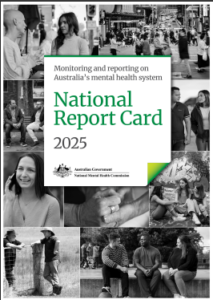 The National Mental Health Commission’s National Report Card 2025 tracks how Australia’s mental health system is performing. It is the third report to use this framework and shows how key measures are changing over time using the latest national survey and government data.
The report covers three domains: Domain 1 – Mental Health, Domain 2 – Social determinants, and Domain – Mental Health System.
Report Card 2025 shows a complex picture. Mental health need remains high, and people with mental health conditions continue to experience poorer wellbeing and greater exposure to social and economic pressures. At the same time, service use and investment have increased. Access remains uneven, cost continues to be a barrier to care, the workforce is not sufficient to meet projected need, and critical data gaps continue to limit understanding of whether services are improving outcomes.
You can access the Report Card 2025 on the National Mental Health Commission website.
From Fragmentation to Framework: Building an Ecosystem of Responses to End Men's Use of Domestic and Family Violence report
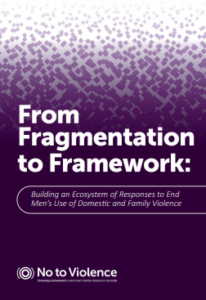 No to Violence has released their latest report, From Fragmentation to Framework: Building an Ecosystem of Responses to End Men’s Use of Domestic and Family Violence, which outlines reforms to identify and engage men earlier, strengthen accountability and improve safety for victim-survivors.
Drawing on insights from practitioners across Australia, the report argues current responses remain fragmented and often intervene only after violence has escalated. Accompanying No to Violence’s 2026-2030 Strategy, the report proposes a more integrated national approach to prevention, intervention and behaviour change, helping build a stronger and more effective response to domestic and family violence. Read the full report.
National Family and Domestic Violence Risk Assessment Framework released
 The National Family and Domestic Violence Risk Assessment Framework, developed by the Department of Social Services (DSS), has been released. The Framework aims to strengthen how frontline services identify and respond to family and domestic violence risk.
In 2024 National Cabinet agreed to develop new national best-practice FDV risk assessment principles and a model best-practice risk assessment framework. DSS led the development of the Framework in partnership with states and territories and relevant Commonwealth agencies. The Framework also incorporates updated national risk assessment principles and risk factors developed by Australia’s National Research Organisation for Women’s Safety (ANROWS), building on the original principles published in 2018.
The Framework, along with a Consultation Summary Report, which captures key insights from stakeholder consultations is available on the Department of Social Services website.
Starting social media younger linked to anxiety, depression in teen years
 New research by UNSW Sydney shows that the age at which adolescents first start using social media may be more important to their mental health than whether they have a social-media account at all.
A survey of 365 Australian adolescents aged 10 to 15, plus one of their parents, found that those who began using social media at a younger age reported more symptoms of anxiety and depression. Simply having a social-media account showed a weaker relationship with those symptoms.
Conducted in the six weeks leading up to the Australian social media ban that came into effect in December 2025, participants were asked if they had ever used social media, the age at which they first used it and whether they currently had a social media account. They were also asked questions to measure symptoms of anxiety and depression.
The researchers found 70% of the youngsters had used social media, about half had a social media account already while the average age they first started using social media was 11 years old.
Study chief investigator Associate Professor Susanne Schweizer said that the research suggests “that delaying children’s first exposure may be a promising policy, especially if paired with training good digital hygiene and citizenship during the delay.”
Read more here.
Teachers' experiences of sexism, misogyny and sexual harassment in Australian schools
 A new study commissioned by the Australian Education Union (AEU) and undertaken by Monash University outlines the increasing problem of persistent sexism and gendered violence faced by teachers.
The report, Duty of Care: Teachers’ experiences of sexism, misogyny and sexual harassment in Australian schools, surveyed 2668 AEU members and is Australia’s largest study of misogyny and gendered violence in Australian schools.
The findings highlight the depth of the issue, including the growing influence of the manosphere on students, and the significant risk of teachers leaving the professions due to misogyny and gendered violence.
Schools have a duty of care for children and young people, but they also have a duty of care for the educators who teach them. This report argues that these responsibilities are inseparable. Preventing gendered violence is essential to fulfilling schools’ obligations as both workplaces and places of learning, and to ensuring every member of the school community is safe, respected and able to flourish.

DSS Children and Family Support Program – FAQs have been updated
 The Department of Social Services has undertaken a comprehensive update of the FAQs for the new Children and Family Support (CaFS) Program. The updated FAQs provide further information about the recommissioning process, Provider Previews, Partnership Tables and the ACCO Transition Form.
The FAQs and other information about the CaFS Program, including the community needs mapping tool, are available on the DSS website.
The health of people in Australia’s prisons 2025
The Australian Institute of Health and Welfare (AIHW) has released its latest data on the health of people in Australian prisons.
People in prison are disproportionately affected by poorer physical, mental, and social outcomes than the general population. They are less likely to access health-care services, and more likely to have a history of at-risk behaviours that can affect health and wellbeing. Most people in prison are there for short periods, and many enter and exit prison multiple times. For this reason, the health of people in prison is public health.
Key findings:
- For nearly 3 in 10 (29%) prison entrants, the highest level of completed schooling was year 9 or below
- 4 in 5 (80%) prison entrants reported using illicit drugs in the previous 12 months
- Around 1 in 3 (34%) prison discharges expected to be homeless once released
- Almost 3 in 5 (57%) prison entrants had a history of a mental health condition.
Read more on the AIHW website.
National Cabinet Meeting – gender-based violence
National Cabinet met in Sydney on Wednesday 26 August 2026.
First Ministers discussed a range of priorities affecting Australians, including Australia’s new artificial intelligence laws, progressing policies to end gender based violence, firearm reform following the horrific antisemitic terrorist attack at Bondi, avian flu transferring to mammals, and fuel security in light of the ongoing serious conflict in the Middle East.
First Ministers re-affirmed their commitment to ending gender-based violence and committed to accelerate efforts to keep women and girls safe.
National Cabinet agreed the priorities for the Second Action Plan to End Violence Against Women and Children:
- improving support for victim survivors to leave violence safely and recover
- intervening earlier to stop violence across health, education and community services
- enhancing supports for children and young people who have experienced violence
- strengthening efforts to prevent and respond to rising rates of sexual violence
- preventing, responding to and countering online harms
- targeting people at risk of using violence and holding perpetrators to account.
Read the communique here.
$3 million boost to support men’s health
Special Envoy for Men’s Health, the Hon Dan Repacholi, has announced the Government will invest $3 million to support the mental health and wellbeing of boys and men, by backing new research from Flinders University that responds to significant gaps in evidence and support for boys’ and men’s mental health.
This investment will be used to help establish the ‘WellMen’: Centre for the Mental Health and Wellbeing of Boys and Men, which will be led by Professor James Smith of Flinders University. WellMen will be supported by a range of industry partners including the Movember Institute of Men’s Health, The Man Cave and Deadly Male.
This funding forms part of a larger investment of $66 million under NHMRC’s Centre of Research Excellence (CRE) 2026 grant opportunity. The CRE scheme provides support for teams of researchers to pursue collaborative research and develop capacity in basic science research, clinical research, health services research and public health research.

Wear it Purple Day
On 28 August 2026 it was Wear It Purple Day, an annual LGBTIQA+SB awareness day especially for young people. This year’s theme, “Colours of Courage”, celebrates the many different forms of courage shown by LGBTQIA+SB young people, allies and communities every day.
Courage can look like speaking up, standing out and creating change. It can also take quieter forms of bravery, like living authentically, coming out, asking for support, standing beside someone, or choosing pride and hope in spaces where being yourself does not always feel easy.
See how FRSA Members around the country celebrated the day:
- Family Life staff and volunteers came together for a special afternoon tea to celebrate the day.
- Unting Country SA’s team wore purple in honour of the day.
- Relationships Australia Tasmania staff wore purple and good vibes to show their support for LGBTQIA+ young people and to recognise the important role we all play in creating spaces where young people feel safe, respected and valued.
- Cafs staff wore purple to show their support for the day.
- Meli staff held a Pride panel discussion on gender, sexuality and inclusive practice. And their Youth Hub hosted a celebration for young people with games, face painting, t-shirt making and a chance to come together.
- Berry Street staff got together to celebrate with a splash of purple in clothes, decorations and food.
- Mission Australia shared their Homelessness and Housing Support team in Broken Hill, NSW in purple.
- MacKillop Family Services held a morning tea for staff and wore purple to show their support for LGBTQIA+ young people and celebrate the diversity that makes our communities stronger.
- Drummond Street Services staff wore purple in honour of the day.
- OzChild staff joined a webinar with Caitlin O’Keeffe-White from the Wear it Purple Youth Action Council, who shared powerful insights into the lived experiences of LGBTQIA+ young people and the importance of creating affirming, inclusive environments.
- Centacare Catholic Community Services’ team wore purple to commemorate the day.
- UnitingCare Queensland’s Early Childhood Approach team in Townsville marked Wear it Purple Day with plenty of colour, creativity and connection, while also challenging their team to celebrate more sustainably. Team members reused items they already owned or visited our Lifeline Shops to thrift pieces for their purple outfits, with decorations and even prizes created with the same sustainability focus. Watch their reel here.

National Child Protection Week- Webinar Series – 2 September to 11 September 2026
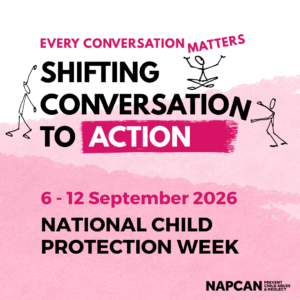 Next week is National Child Protection Week, from 6-12 September 2026. This year’s theme is Every Conversation Matters, Shifting Conversation to Action – driving a stronger national focus on shifting conversations into meaningful action.
As part of the week NAPCAN are running a webinar series from 2 September to 11 September 2026, find out more about each webinar below:
- 2 September – Supporting children and young people with disability experiencing family violence
- 4 September – Launch of National Child Protections Week 2026
- 7 September – Beyond the commissions, inquiries, and reviews: we have the evidence to protect our children, now where’s the action?
- 8 September – Boys, Belonging and the Manosphere: Early Action in a Digital Age
- 9 September – Beyond “tough on crime”: preventing youth offending with early support, strong families and connected communities
- 11 September – From Voice to Action: Safe and Meaningful Youth Engagement Across All Ages and Stages
Help shape the future of Aboriginal Family-Led Decision Making in Australia
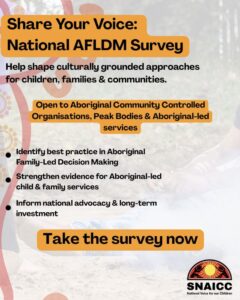 SNAICC is inviting Aboriginal Community Controlled Organisations, Peak Bodies and Aboriginal-led services to participate in a national survey on Aboriginal Family-Led Decision Making (AFLDM). The survey will help identify best-practice approaches, strengthen the evidence base for Aboriginal-led child and family services, inform national advocacy and reform priorities, and support long-term culturally governed investment. SNAICC is encouraging organisations working with Aboriginal children, families and communities to share their experiences and insights to help shape the future development and implementation of AFLDM across Australia.

CHC81015 Graduate Diploma of Relationship Counselling – June 2026, Online
CHC81115 Graduate Diploma of Family Dispute Resolution – July 2026, Online
Couples Counselling Course: A contemporary and client-focused approach

ACT
Communities of Practice Project Officer | Family & Relationship Services Australia (FRSA)
NSW
RELATIONSHIP COUNSELLOR | Interrelate
WA
General Manager Family Law Services | Centacare Family Services
If you have any events you’d like listed on the FRSA Events and Training Calendar or job vacancies you’d like listed on the FRSA Jobs Board, email Communications Officer, Vanessa Lam at communications@frsa.org.au. Please note that posting onto the FRSA website is reserved for FRSA Members only.

Pathways to onset of contact child sexual abuse: a rapid evidence review | Australian Institute of Criminology
 This paper presents results from a rapid evidence review of 23 empirical studies to examine pathways to the onset of contact child sexual abuse offending. Fifteen developmental, individual and situational or facilitating factors were identified as contributing to the onset of offending. Primary and secondary prevention approaches are proposed to disrupt pathways to offending.
Sistergirls, brotherboys and trans and gender diverse mob: A cross-sectional study of mental health, social determinants and service access | First Nations Health and Wellbeing: The Lowitja Journal
Aboriginal and Torres Strait Islander trans and gender diverse people are included in some health and wellbeing research; however, they are often a small group within a larger sample of cisgender lesbian, gay and bisexual people. This study addresses this gap by examining gender diverse mob’s mental health, social determinants of health and access to healthcare services.
Measuring Early years Mindsets | Frameworks Institute, Curijo & Minderoo Foundation
 In this report, outlined is a set of findings from a nationally representative descriptive survey conducted in February 2026. In the survey, we measured the strength of a set of mindsets Australians use to think about early childhood and examined how these mindsets vary across groups, how they interconnect or “cluster” and how they relate to support for solutions. Based on these findings, we offer initial recommendations for how to navigate the complex terrain of mindsets that shape public thinking.
Can nature play support children’s relationships with family and peers? | Australian Institute of Family Studies
Research suggests that nature play can support children to build and strengthen positive relationships with family members and peers. This resource highlights characteristics of nature play that encourage meaningful interactions. It also outlines some considerations for practitioners to support families and children to engage in nature play.
Priced out: an income test for Australia’s rental market | Everybody’s Home
 This report compares rents across Australia with a range of annual incomes. It provides a picture of how affordability changes across the income distribution and identifies the point at which households can reasonably expect to rent without experiencing housing stress. It finds that the private rental market is increasingly failing households across the income spectrum.
Realising the promise of Thriving Kids | Brotherhood of St Laurence
 This paper welcomes Thriving Kids as a significant opportunity to develop an integrated early childhood development system but notes the challenges of translating the system vision into practical reality. It highlights key issues around the design of Thriving Kids, including resourcing, equitable access and transition considerations.
Misogyny, Online Radicalisation, and Youth Extremism in Australia | University of Melbourne
This report details the findings of an Australian government-funded research project into misogyny and youth radicalisation in Australia and presents evidence-based policy recommendations arising from a comprehensive, multimethod research program on misogyny, online behaviour, and violent extremism in Australia. You can also read this related article, Hostile attitudes toward women are driving extremism in young Australians.
News and young Australians in 2026- How children and teens access, perceive and understand news media | Western Sydney University, Queensland University of Technology & University of Canberra
 The latest Australian longitudinal survey of young people aged 10–17 highlights significant changes in how young people access and engage with news. Family remains their primary news source, but news engagement becomes increasingly digital and independent as young people enter their teenage years. Active engagement has declined since 2023, while generative AI is now a commonly used source of news and many young people lack confidence in identifying misinformation. The findings also suggest young people want news that reflects their lives and that news literacy education can strengthen digital media knowledge and civic participation.
The costs and benefits of fully meeting demand for specialist family violence services in Victoria | Safe and Equal
This report examines the investment needed to ensure every victim survivor in Victoria can access timely, specialist support – and the significant social and economic benefits that would follow. It finds that an investment of $487 million in specialist family violence services in 2026–27 would generate around $2.8 billion in social and economic benefits.
Understanding experiences of family violence and implications for women’s psychological wellbeing | First Nations Health and Wellbeing: The Lowitja Journal
This study, guided by longstanding Aboriginal governance and culturally safe research practices, explored the impact of family violence on Aboriginal and Torres Strait Islander women’s psychological wellbeing and experiences of motherhood. Findings from a representative South Australian cohort highlight how cultural identity, community connections, and supportive relationships can strengthen wellbeing and help mitigate the impacts of family violence.
Parenting supports that help children with disability thrive- Parenting Today Insight Brief | Parenting Today
 The 2025 Parenting Today national survey of more than 10,000 Australian parents highlights the experiences of parents of children aged 0–8 with disability-related support needs. The findings point to increased emotional strain and concerns about meeting parenting expectations, while also showing that parents are motivated to seek help. The brief highlights the need for accessible, timely and evidence-based supports, alongside trusted information and family-centred service pathways that are responsive to families’ circumstances and reduce barriers to participation.
Want to submit something to the FRSA eBulletin?
If you have an news item or event that you would like to be featured in a future eBulletin please submit your announcement via the form below or email communications@frsa.org.au with the subject “FRSA eBulletin submission”.
Please note FRSA members receive priority for items posted in the eBulletin. And to keep information current, relevant and useful, submissions will not be repeated from week to week.
Subscribe
Subscribe to receive future eBulletin editions directly to your inbox!
